
Blog
Food-Contact Compliance for Customized Pouches: The Documents to Request in 2026
Ask a pouch supplier for their food-safety paperwork and you will usually get one of two things: a certificate-shaped PDF with the words “FDA approved” on it, or an apology. Neither is a compliance file. What a serious buyer actually needs is a set of documents tied to the specific structure, the specific market and the specific way the food is filled, stored and reheated.
This has become more urgent in 2026, for two reasons. In the European Union, the Packaging and Packaging Waste Regulation (EU) 2025/40 applies from 12 August 2026, bringing heavy-metal limits, PFAS thresholds and a Declaration of Conformity obligation for packaging placed on the EU market. In the United States, the FDA completed its market phase-out of PFAS-based grease-proofing substances for food packaging in February 2026, and roughly a dozen states now run their own restrictions on top of federal clearance.
This guide is the working version of that paperwork: what exists, what the words on each document mean, what to ask for by name, and the handful of places compliance quietly falls apart between the sample and the container.

“Is your pouch FDA approved?” is the wrong question
A laminated pouch is not one material. It is a stack: an outer print film, an ink layer, an adhesive, one or more barrier layers, and a food-contact sealant layer on the inside. Each layer has its own regulatory status, and the layer that touches your product is the one that carries the strictest duty.
On top of that, compliance is conditional. Migration limits are set against how the material is used — the type of food (fatty, aqueous, acidic, dry), the temperature, the contact time. A structure validated for a dry snack at room temperature is not automatically compliant for a hot-fill sauce, a 121 °C retort cycle or a microwave cook cycle. This is why “we are FDA compliant” tells you almost nothing on its own: compliance belongs to a structure used under stated conditions, not to a factory.
The document set to request — by name
These eight documents are what a competent converter can produce. Ask for them together, as a package per structure, and keep them with the specification for that SKU.
| Document | What it proves | Who issues it |
|---|---|---|
| Declaration of Compliance (DoC) | The structure complies with the food-contact framework for the stated use conditions, layer by layer | The converter / laminator |
| Migration test report | Overall and specific migration stay within limits under stated simulants, time and temperature | Accredited third-party lab |
| FDA food-contact statement | Which US clearance route applies — 21 CFR citation, Food Contact Notification (FCN) number, or a letter of guarantee | Converter, with film and ink suppliers |
| Ink and adhesive statements | Printing inks and adhesives meet the recognised positive lists for non-food-contact-side printing | Ink and adhesive makers |
| Heavy metals statement | Lead, cadmium, mercury and hexavalent chromium are below the packaging limits | Converter / lab report |
| PFAS and total-fluorine statement | Whether fluorinated substances are present, and at what level, for food-contact packaging | Converter / lab report |
| Bisphenol (BPA) statement | The structure does not use restricted bisphenols in food-contact layers | Converter / material supplier |
| Food-contact layer declaration | Exactly which film, gauge and grade sits against the food | Converter |
Ask for the package per structure and per SKU — not one folder for the whole factory. If the food-contact layer, gauge or ink changes, the papers change with it.
The US side: clearance, not approval
There is no such thing as an FDA-approved pouch. The FDA regulates food-contact substances as indirect food additives, and clearance happens through defined routes: a listing in Title 21 of the Code of Federal Regulations (for example the polymer listings in 21 CFR 177, adhesive listings in 21 CFR 175.105), a Food Contact Notification filed by a specific company for a specific substance, or the threshold-of-regulation exemption for negligible migration.
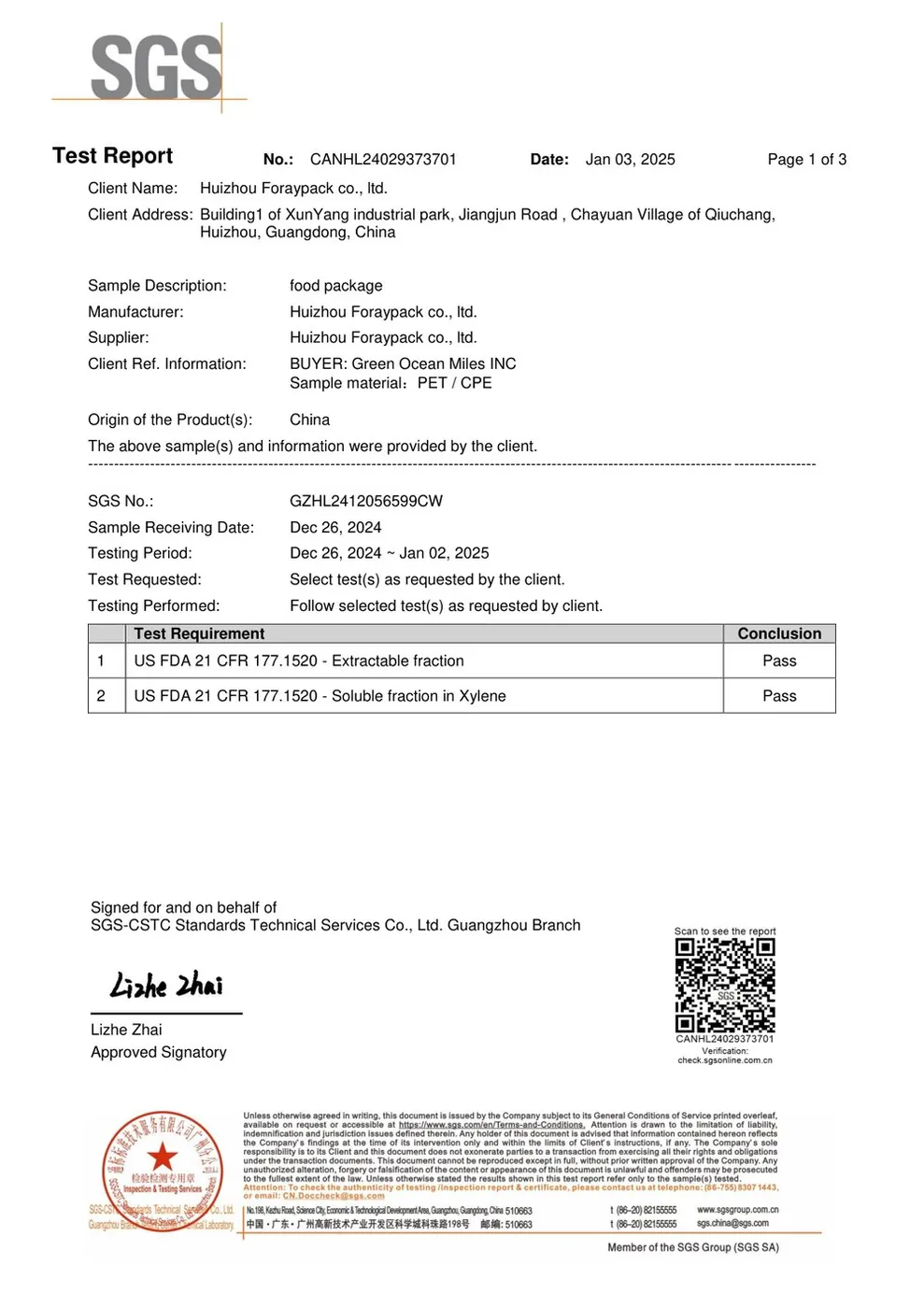
What this means practically for a buyer: ask for the citation, not the adjective. A useful US statement names the regulation or FCN that covers the material, and comes with a letter of guarantee so your own downstream obligations are covered. We have our FDA 21 CFR 177 test report issued by SGS, and we supply it on request — that is the shape of document to expect from any converter.
Federal clearance is also not the end of the story in the US. States can and do go further: PFAS restrictions in food packaging are in force in California, New York, Maine, Minnesota, Vermont, Washington and others, and California’s Proposition 65 puts the burden on the seller to warn about listed substances — which is why benzophenone in printing inks, BPA and certain phthalates come up in packaging conversations at all. Compliance with a federal standard does not satisfy a stricter state rule.
The EU side: what actually changed on 12 August 2026
The EU food-contact framework has three layers, and buyers routinely conflate them.
- Framework Regulation (EC) 1935/2004 — the general duty: materials must not transfer constituents into food in quantities that endanger health or unacceptably change the food.
- Good manufacturing practice (EC) 2023/2006 — quality assurance so specifications stay within limits batch after batch.
- Plastics Regulation (EU) 10/2011 — the one that matters most for laminated pouches: a positive list of authorised substances, specific migration limits per substance, an overall migration limit (OML) of 10 mg/dm² or 60 mg/kg of food, and a mandatory Declaration of Compliance with supporting documentation behind it.
Printing inks sit outside that harmonised system, which surprises buyers. There is no EU-wide ink regulation; instead the practical standards are the Swiss Ordinance SR 817.023.21 (Annex 10, a positive list of ink ingredients for the non-food-contact side), the EuPIA guideline and exclusion list, and national rules such as the German printing ink ordinance, fully applicable since 1 January 2026. A supplier who cannot say which of these their ink system is built against has not finished the work.
Then comes the new layer. Regulation (EU) 2025/40, the Packaging and Packaging Waste Regulation (PPWR), entered into force on 11 February 2025 and applies generally from 12 August 2026, replacing the old Packaging Directive. For packaging placed on the EU market it introduces:
- Heavy metal limits — combined lead, cadmium, mercury and hexavalent chromium at no more than 100 mg/kg.
- PFAS thresholds for food-contact packaging — individual non-polymer PFAS below 25 ppb, the sum of non-polymer PFAS below 250 ppb, and total fluorine (including polymeric PFAS) below 50 ppm; where total fluorine exceeds that level, extra documentation is required.
- A Declaration of Conformity per packaging type, supported by technical documentation, for packaging placed on the market.
- Recyclability requirements — all packaging recyclable to at least grade C from 1 January 2030, rising to grades A or B from 2038.
- Recycled content targets for plastic packaging from 2030, differentiated by contact-sensitive and other applications.
- Packaging minimisation, plus rules tightening what “compostable” may claim.
One responsibility boundary matters more than the rest: PPWR duties attach to the operator placing the packaging on the EU market — normally the brand or importer, not the converter in Asia. If you are exporting into the EU, you (or your importer of record) draw up the Declaration of Conformity, register with the national EPR scheme of each market and keep the technical file. Your pouch supplier’s job is to hand you the data that makes that file defensible: composition, migration data, ink system, food-contact layer, statements. Ask for it early, because an EPR registration without technical documentation is a form without a foundation.
PFAS in plain terms: what a pouch buyer should actually take away
PFAS were used for decades as grease-proofing agents on paper and paperboard — wrappers, pizza boxes, microwave popcorn bags, moulded fibre bowls. Laminated film pouches never depended on them for grease resistance, because a polymer sealant layer does that job structurally.
The regulatory timeline nevertheless now touches packaging teams:
- The FDA revoked authorisation for long-chain PFAS in food contact in 2016, secured a voluntary phase-out of subsequent generations from 2021, formally ended 35 food-contact notifications covering PFAS in paper and paperboard in January 2025, and announced the phase-out complete in February 2026. PFAS-based grease-proofing is no longer being sold into the US market for food contact.
- Around a dozen US states have their own PFAS restrictions in food packaging, several going beyond the federal position.
- The EU now applies the PPWR thresholds above, and a broader REACH restriction on PFAS continues its passage through the EU process.
For a film pouch, the practical takeaway is simple: get a written statement on file — no intentionally added PFAS, and total fluorine below the applicable threshold where the EU is your market — and do not put a “PFAS-free” claim on a package you cannot document. Claims without a test report behind them are exactly the kind of thing that turns into a retailer audit problem two shipments later.
Where compliance quietly breaks
- A letter instead of a citation. “All our materials are FDA approved” on an unsigned page is worth nothing. Look for regulation numbers, FCN numbers, signatories, dates.
- A DoC for a different structure. Wrong gauge, wrong film supplier, wrong laminate, an added valve fitment — any of these can put the shipped pouch outside the tested scope.
- Migration data at the wrong temperature. A retort pouch validated only at ambient conditions is not validated. Simulants, time and temperature must match your filling and shelf-life reality.
- Recycled content without authorisation. Recycled plastic in food-contact layers needs an authorised recycling process; recycled content claims in a market that regulates food-contact recycling are not a marketing decision.
- “Biodegradable” claims. Under PPWR, compostable packaging must increasingly be designed for material recycling, and unqualified degradability language is being squeezed out. Say what is certified, not what sounds green.
- One file for all markets. EU and US documentation sets are different, and Northern Ireland follows EU packaging rules under the Windsor Framework while Great Britain does not. Market-specific files, always.
- Forgetting that changes trigger re-verification. New film supplier, new gauge, new ink, added zipper or valve, a switch to mono-material for recyclability: each is a re-test event, not an administrative note.
The ten-line email that gets you the right answers
Copy this into a message to any supplier you are evaluating — ours included:
- 1. Please send the Declaration of Compliance for this exact structure, with the food-contact layer identified.
- 2. Which migration tests support it — simulants, time, temperature — and when were they run?
- 3. Which US clearance route applies to each layer: 21 CFR citation or FCN number?
- 4. Which positive list is your ink system built against: Swiss Ordinance, EuPIA, or a national ink ordinance?
- 5. Do you have a heavy metals statement for this packaging?
- 6. Do you have a PFAS and total-fluorine statement? At what level?
- 7. Is there a bisphenol statement for the food-contact layers?
- 8. What are the stated conditions of use for this structure — food type, maximum temperature, contact duration?
- 9. Which changes would require re-testing, and who notifies whom?
- 10. Can you supply the technical documentation our market’s registration and EPR reporting will need?
If you are choosing a converter rather than a pouch, our 12 questions for vetting a pouch manufacturer covers the commercial side of the same decision. If the immediate question is which structure your product needs, start with the format comparison or the flexible packaging overview, then bring compliance into the conversation at the structure stage — not after artwork is signed off, when changing a layer is expensive.
How we handle it
Our packaging complies with FDA 21 CFR 177 in the United States and with the (EC) 1935/2004 framework plus the (EU) 10/2011 family of requirements in Europe; we operate an ISO 9001 quality management system, hold BPA-free reports and are registered under the German LUCID packaging register. Third-party test reports — including the SGS report above — are available on request, and we name the food-contact layer of every food structure we quote, because that is the layer your own compliance file rests on.
What we do not do is pretend compliance is a conclusion we can hand over. Which market you sell in, who registers with which authority, what you may print on the pack: those decisions belong to you and your importer. Our part is to give you accurate technical data, keep it current, and tell you when a proposed change would require re-testing — before the change is made rather than after the shipment leaves.
If you are preparing a launch for either market, send us the product, the market and the use conditions. We will come back with a structure proposal and the documentation set that matches it — and where the food-contact requirements for your specific product are outside what we convert, we will say so.
Regulatory summary correct to our knowledge as of 30 September 2026 and provided for orientation, not as legal advice. Requirements change and interpretations differ by member state; verify against the official texts — EUR-Lex for (EU) 2025/40, (EU) 10/2011 and (EU) 2024/3190, and the FDA’s food-contact pages for US clearance — and take advice for your own market.
Frequently asked questions
Is there such a thing as FDA-approved packaging?
No. The FDA clears food-contact substances rather than approving finished packaging, and it does so through defined routes — a listing in Title 21 of the CFR, a Food Contact Notification, or the threshold-of-regulation exemption. You are looking for a citation and a test report, not the word “approved”. A letter of guarantee is also useful, because it covers your own downstream position as the seller of the packaged food.
Do I need PFAS testing for a plastic pouch?
PFAS historically entered food packaging as grease-proofing on paper and fibre items, not on laminated film pouches. That said, the EU now applies PFAS thresholds to food-contact packaging under PPWR, including a total-fluorine figure, so for an EU-bound product you should hold a written statement with the measured level. For the US market, keep the same statement on file alongside your state-level review, since around a dozen states restrict intentionally added PFAS in food packaging.
Does one Declaration of Compliance cover all my pouch sizes?
Only if the structure and use conditions are genuinely the same. A DoC covers a defined material combination used within stated conditions — film grades, gauges, adhesives, ink system, food type and temperature range. Change the size of a pouch without changing the layers and the declaration usually still applies; change the film, the gauge, the ink or add a valve or spout, and the declaration has to be reissued or re-tested.
How long does the documentation take to obtain?
It depends on whether the structure already exists in the converter’s tested library or has to be built and tested. Off-the-shelf structures with existing reports can be documented quickly; a new laminate, a new ink system or a retort-grade structure needs third-party migration testing, which takes weeks in a lab calendar. Build that into your launch timeline rather than discovering it at the artwork stage — we flag lead times with the quote.
Who is responsible for PPWR compliance — me or my supplier?
The duties attach to the operator placing the packaging on the EU market, which is normally the brand or the importer of record, not the converter. That means you, or your importer, draw up the Declaration of Conformity, keep the technical documentation and register with the national EPR scheme in each market where you sell. Your supplier’s obligation is to give you accurate composition, migration and materials data so that file stands up. Note that Northern Ireland follows EU packaging rules while Great Britain does not.
We plan a mono-material switch for recyclability. Does that affect compliance?
Yes, and it should be planned as a compliance project, not only a materials project. Moving to a mono-material or higher recycled-content structure changes the layers, the adhesive system and sometimes the ink, and recycled plastic in food-contact layers needs an authorised recycling process. Under PPWR, packaging must be recyclable to at least grade C from 2030 and to grade A or B from 2038, with recycled content targets from 2030 — so the sensible sequence is to design the recyclable structure now, re-test it once and document it properly, rather than retrofit later.
Related reading
Related: Certifications and testing
Preparing a launch in the US or the EU?
Send the product, the market and how it will be filled and stored. We come back with a structure proposal and the food-contact documentation set that matches it, usually within one working day.