
Pet Food Packaging for Brands
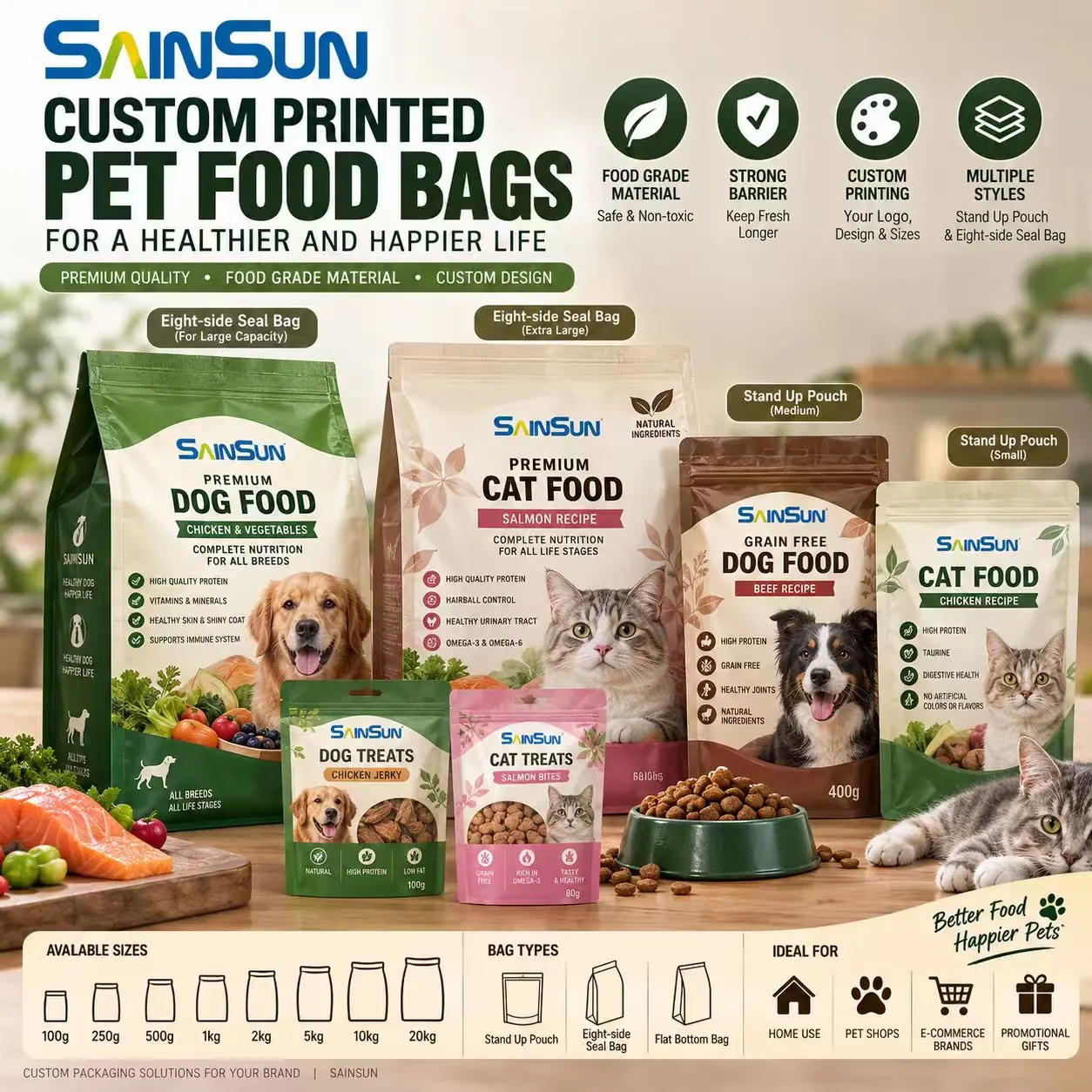
Pet food is one of the toughest tests in flexible packaging: kibble is dense and sharp-edged, fat content attacks weak films, and the pack is opened hundreds of times before it is empty. We build pet food packaging for that reality — from 50 g treat pouches to 5 kg dry food bags.
Key Features
- Puncture-resistant laminates for dense, sharp kibble
- Wide resealable zippers — the feature owners judge a bag by
- Treats, dry food, freeze-dried and wet formats under one supplier
- FDA and EU food-contact reports; BRCGS Issue 7 (Grade B) system
Key Takeaways
Pet Food Packaging Decisions at a Glance
- Dry food needs puncture resistance plus an oxygen and moisture barrier — foil or metallized laminates carry the shelf life.
- Wide resealable zippers are the single most judged feature on a repeat-purchase pack.
- Treats run 50–500 g stand-up pouches; dry food runs 1–5 kg flat-bottom or side-gusset bags with a handle.
- Freeze-dried products live or die on moisture control — foil barrier and a strong zipper are standard.
- MOQ 100–500 pcs per design for standard structures; 5,000 pcs for wet-food and retort formats.
The Problem
What Pet Food Does to a Pack
Kibble is abrasive. Through a long distribution chain — pallets, trucks, shelves, a shipping box, a kitchen cupboard — the pack is compressed and rubbed far more than a typical snack bag. Films that look fine on a spec sheet fail in the corner seams of a 2 kg bag.
Fat is the second enemy. Oils migrate through poor barrier films, softening seals and carrying odour. And because a pet food pack is opened daily for weeks, the reclosure takes more abuse than almost any other consumer package.
None of this is exotic — it is a checklist. Puncture-resistant outer film, a barrier layer matched to fat and moisture, reinforced seals and corners, and a zipper that survives hundreds of open-close cycles. We confirm all four on the sample pack before production.
Structures
Pet Products and the Packs That Suit Them
| Product | Recommended format | Typical structure | Closures |
|---|---|---|---|
| Dry food 1–5 kg | Flat-bottom or side-gusset bag | PET/AL/PE or PET/VMPET/PE, reinforced | Handle + wide zipper |
| Treats 50–500 g | Stand-up pouch | PET/VMPET/PE | Resealable zipper |
| Freeze-dried | Stand-up pouch | PET/AL/PE — moisture dominates | Strong zipper |
| Wet food & toppers | Spouted or retort pouch | Foil laminate with fitment or RCPP | Screw cap / retort seal |
| Dental sticks & chews | Stand-up or flat pillow bag | PET/VMPET/PE | Zipper or tear notch |
| Supplements & powders | Stand-up or three-side-seal | PET/AL/PE | Zipper / scoop / tear notch |
Wet-food and retort structures are functional builds with an MOQ of 5,000 pcs per design.
Decisions
What Owners Judge a Pet Pack By
The zipper
The most-used feature on the pack. Wide, smooth and durable beats almost everything else on repeat purchase.
Standing up
A flat-bottom bag presents the brand and survives shelf handling better than a soft stand-up pouch at 2 kg+.
Portion visibility
A clear window or printed portion guide helps owners trust the fill and the feeding amount.
Carry comfort
Handles on 2 kg and heavier packs — die-cut or applied — are a small cost with a large perceived-value gain.
Odour control
A real barrier layer keeps fat odour in the bag, not in the cupboard.
Sustainability story
Mono-material PE structures and kraft-look laminates support recyclability claims where they are true.
Specifications
What We Supply
| Item | Standard options |
|---|---|
| Formats | Flat-bottom, side-gusset, stand-up, spouted and retort pouches |
| Structures | PET/AL/PE · PET/VMPET/PE · kraft/PE · mono-material PE; RCPP sealant for retort |
| Pack sizes | 50 g treats to 5 kg dry food, plus fully customized dimensions |
| Printing | Rotogravure and flexographic, up to 10 colours; matte, gloss, kraft-look, soft-touch |
| Closures | Wide zipper, handle, tear notch, screw cap (spouted), retort seal |
| MOQ | 100–500 pcs per design standard; 5,000 pcs for spouted and retort structures |
| Customized samples | 5–7 days · US$120 for 1–2 pcs · print film fee waived |
| Compliance | FDA 21 CFR and EU 10/2011 food-contact reports; produced under BRCGS Issue 7 (Grade B) |
Tell us the kibble profile, fat content and target shelf life — we will propose two or three structures with the trade-offs spelled out.
Verification
We Test the Pack Like a Dog Attacks It
Sample packs go through seal-strength checks, drop tests and repeated open-close cycles on the zipper before we quote a structure as production-ready. For retort wet food, sample packs are run through the actual sterilization profile, and we film the boil test so you can see it.
That habit exists because pet food failures are expensive in a way snack failures are not: a split 2 kg bag is not one lost sale, it is a lost customer and a damaged brand.
Compliance documentation ships with every order — FDA 21 CFR and EU 10/2011 food-contact test reports, produced under our BRCGS Issue 7 (Grade B) system.
FAQ
Pet Food Packaging — Common Questions
Which barrier suits dry pet food?
Dry kibble is fat-rich and moisture-sensitive: a foil or metallized layer with a puncture-resistant outer is the usual structure. For freeze-dried products, moisture control dominates — an aluminium-foil barrier with a strong zipper is the standard answer.
Can heavier packs carry a handle?
Yes. Die-cut or applied film handles are standard on 2–5 kg flat-bottom and side-gusset packs, and we reinforce the handle zone in the film specification so it survives carrying a full bag.
What packaging suits pet treats?
Stand-up pouches from 50 g to 500 g with a resealable zipper. Treats are opened repeatedly, so the zipper quality matters more than almost any other feature.
How is wet pet food packed?
Either in spouted pouches with a screw cap for toppers and broths, or in retort pouches for sterilized shelf-stable wet food. Both are functional structures with an MOQ of 5,000 pcs per design.
What compliance documents do you supply?
FDA 21 CFR and EU 10/2011 food-contact test reports, produced under our BRCGS Issue 7 (Grade B) system — the documents importers and retail chains ask for first.
Can you match my current bag?
Send the bag or its dieline. We match the format, film, closures and print, and will point out where a structure change could improve shelf life or reduce cost.
Next Step
Explore Pet Food Packaging Formats
The pet food page covers dry kibble, treats and wet formats. Stand-up pouches cover the 1–5 kg retail bag most owners pick up off the shelf.
Next Step
Send the Kibble Profile, Get the Structure
Tell us the product, fill weight and target shelf life. We will propose structures that survive the category — with samples in 5–7 days.
Last updated: September 2026