
Packaging for Ready Meals and Retort Foods
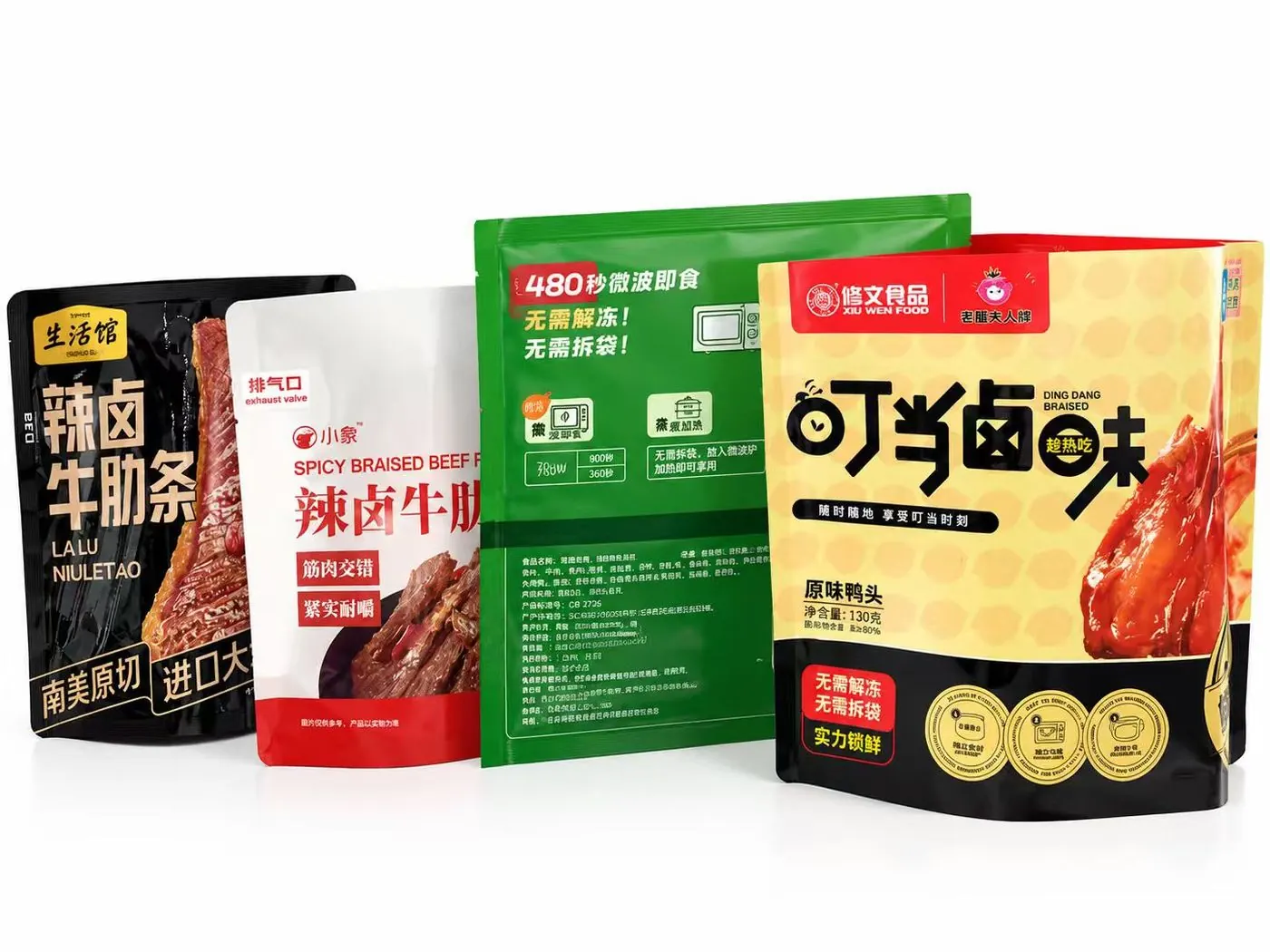
Two technologies dominate this category. Retort pouches are sterilized after filling, so the meal is shelf-stable without a cold chain. Microwave-ready venting bags go from freezer to microwave without opening. We produce both — and we test both in real conditions before you commit to volume.
Key Features
- Retort structures rated for 121°C and 135°C cycles
- Self-venting microwave bags — freezer to table in one pack
- PET / NY / Al / RCPP four-layer retort laminate
- MOQ 5,000 pcs per design; samples tested before production
Key Takeaways
Ready-Meal Packaging at a Glance
- Retort pouches survive 121–135°C sterilization, giving ambient shelf life with no cold chain.
- The retort structure is PET / NY / Al / RCPP — the RCPP sealant is what survives the cycle.
- Microwave venting bags reheat frozen meals in the pack, with a self-venting structure that releases steam safely.
- Both are functional structures: MOQ 5,000 pcs per design, with sample testing before mass production.
- Sample pouches are run through the real sterilization or boiling cycle — we film the test.
The Two Paths
Shelf-Stable or Freezer-to-Microwave
Retort is the logistics story: sterilize the filled pouch and the meal stores at ambient temperature for a long shelf life, with no refrigeration anywhere in the chain. The cost is a more demanding pack — it must survive pressure, heat and flexing through the cycle without delaminating or leaking.
Microwave-ready venting is the convenience story: the pack holds a frozen or chilled meal and goes straight into the microwave, where a self-venting structure releases steam gradually so the food reheats in its own moisture. No thawing, no transferring, no second container to wash.
Both formats share one rule: the structure has to be proven against the real process, not an approximation of it. That is what our sample round exists for.
Structures
Ready-Meal Products and Their Packs
| Product | Format | Typical structure | Process |
|---|---|---|---|
| Sterilized meals & dishes | Retort pouch | PET / NY / Al / RCPP | 121–135°C retort cycle |
| Sauces, broths & braises | Retort pouch or spouted retort | Foil laminate / fitment weld | Retort + screw cap |
| Frozen dumplings & buns | Microwave venting bag | Self-venting laminate | Straight to microwave |
| Rice & noodles | Retort flat pouch | PET / NY / Al / RCPP | Boil or retort |
| Instant porridge & soups | Retort pouch | Foil laminate | Retort cycle |
| Ready-to-drink formats | Spouted pouch | PET/AL/PE with fitment | Hot-fill or retort |
Every structure above is quoted after a sample round through your actual process parameters.
Why It Matters
What the Right Pack Changes
Cold-chain cost
Shelf-stable retort removes refrigeration from warehousing, shipping and retail display.
Shipping weight
Flexible pouches weigh far less than cans and trays, and ship flat before filling.
Reheat convenience
Venting bags reheat the meal in its own pack — moist, even and with nothing to wash.
Brand surface
The full pouch prints with artwork, portion guidance and preparation steps.
Portion control
Single-serve retort packs suit foodservice, travel and convenience retail.
Export reach
Ambient shelf life opens markets where cold chain is unreliable or uneconomic.
Specifications
What We Supply
| Item | Standard options |
|---|---|
| Retort structures | PET / NY / Al / RCPP four-layer laminate, rated for 121°C and 135°C |
| Venting structures | Self-venting microwave laminates with controlled pressure release |
| Formats | Flat retort pouches, stand-up retort, spouted retort, microwave venting bags |
| Printing | Rotogravure and flexographic, up to 10 colours |
| Verification | Seal-strength checks, boil tests and retort cycle runs on sample packs |
| MOQ | 5,000 pcs per design (functional structure) |
| Customized samples | 5–7 days · US$120 for 1–2 pcs · print film fee waived |
| Compliance | FDA 21 CFR 177.1520 and EU 10/2011 reports for retort structures; BRCGS Issue 7 (Grade B) |
Share your product, target temperature, cycle time and retort equipment — we engineer the structure against those numbers.
Proof
The Sample Round Is the Whole Ballgame
In this category, a quotation without a tested sample is a guess. Seal strength, delamination resistance and venting behaviour only show themselves under the real temperature curve and the real pressure cycle.
So we make sample packs first, run them through your sterilization profile or a boiling test, and only then quote production. Our retort product page carries a video of a boiling test on our own pouches — we would rather show the result than describe it.
Compliance documents for retort structures — FDA 21 CFR 177.1520 and EU 10/2011 — are supplied with the order, produced under our BRCGS Issue 7 (Grade B) system.
FAQ
Ready-Meal Packaging — Common Questions
What is the difference between retort and microwave-ready bags?
A retort pouch is filled and then sterilized at 121–135°C, making the food shelf-stable without refrigeration. A microwave-ready venting bag is packed frozen or chilled and reheated straight in the bag — a self-venting structure releases steam while it heats. Different processes, different structures.
What structure does a retort pouch use?
A four-layer laminate — PET for print, nylon for puncture resistance, aluminium foil as the barrier core, and RCPP as the retort-grade sealant. The sealant is what survives the sterilization cycle; an ordinary PE sealant does not.
What is the MOQ for retort and microwave bags?
5,000 pcs per design. Both are functional structures with a higher film and process specification than a standard pouch.
Can you match our sterilization profile?
Yes. Share the product, target temperature (121°C or 135°C), cycle time and retort equipment. We engineer the structure, make sample packs, and confirm seal performance before mass production.
How do you prove the pouch survives the process?
Sample packs are run through the real sterilization or boiling cycle. On the retort product page you can watch a boiling-test video of our pouches — we test before quoting production, not after.
Do retort pouches really replace frozen distribution?
For many products, yes. A sterilized retort pouch is shelf-stable at ambient temperature, which removes cold-chain cost entirely. Whether it suits your product depends on texture and flavour tolerance to the sterilization cycle — which is exactly what the sample round is for.
Next Step
Explore Retort and Microwave Formats
Retort pouches for shelf-stable lines, microwave-ready bags for freezer-to-microwave meals — both are pressure- and seal-tested before production.
Next Step
Send the Process, We Will Prove the Pack
Tell us the product, the target temperature and the cycle time. We will build sample packs, run them through the real process, and quote from evidence.
Last updated: September 2026