
Blog
Microwave Cooking Bags and Retort Pouches: How to Choose
Short answer: a retort pouch is sterilized after it is sealed — typically at 121°C or 135°C in a steam-pressure vessel — so the food inside becomes shelf-stable at room temperature. A microwave cooking bag is never sterilized; the customer heats the food in the sealed pack, and an engineered vent releases steam so the pouch warms instead of bursting. If you need ambient shelf life and export, you need retort. If you sell frozen convenience food, you need microwave venting.
Both products arrive in buyer inquiries described the same way — “a bag that can take heat” — and some suppliers will quote both without asking which life the pack is built for. They are different packages with different films, different seals and different failure modes. This guide separates them, shows what each one is made of, and lists what to specify before you ask for a price.
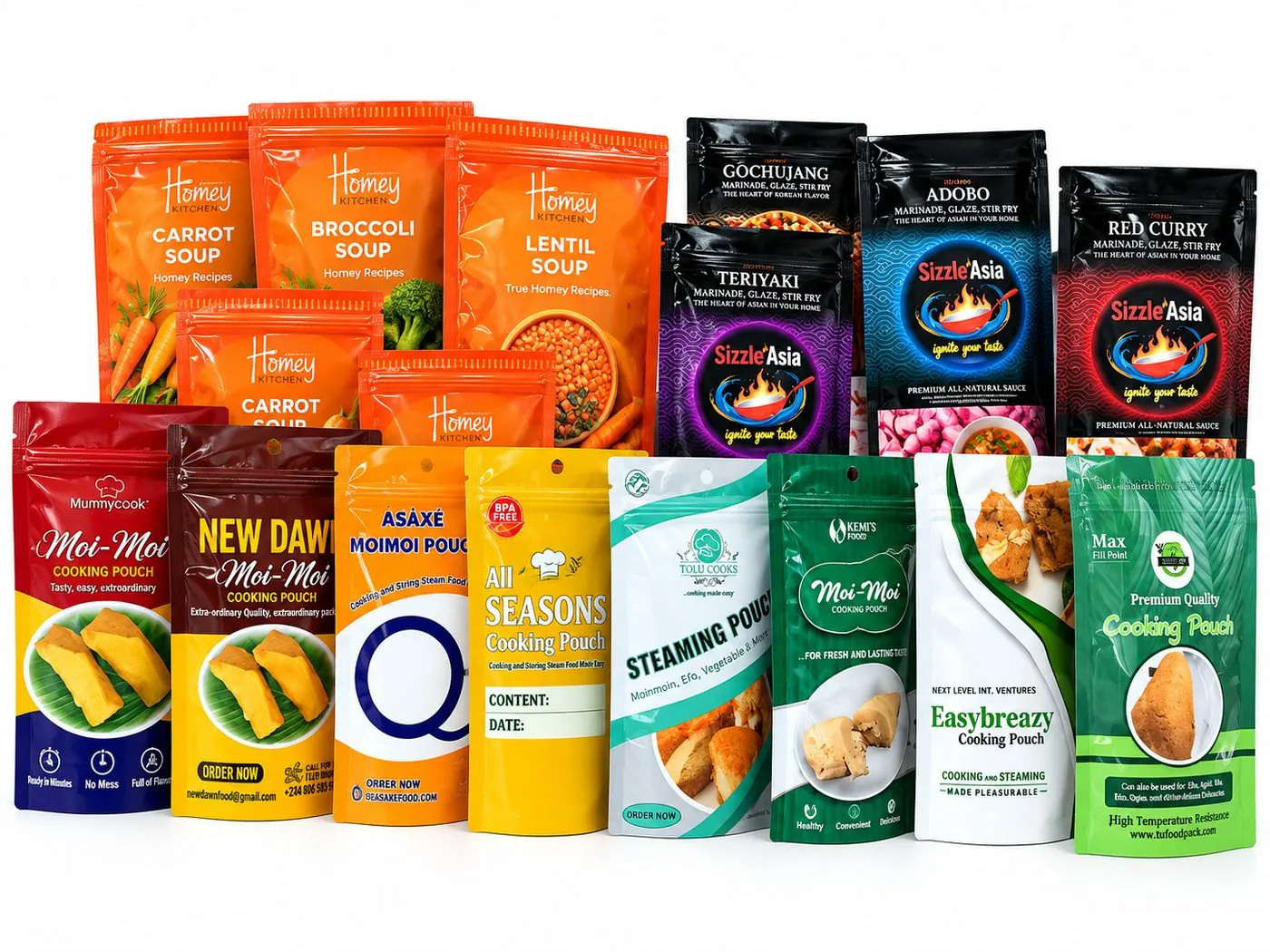
One pack is sterilized in the factory; the other is heated by the customer
The fastest way to keep the two formats straight: retort happens in the factory, microwaving happens in the customer’s kitchen. Everything else follows from that.
| Retort pouch | Microwave cooking bag | |
|---|---|---|
| What the heat does | Sterilizes the sealed product | Reheats or cooks food at the point of eating |
| Where it happens | Factory autoclave, after sealing | Consumer’s microwave |
| Result | Ambient shelf-stable, no cold chain | Frozen or chilled until use |
| Seal requirement | Hermetic, survives pressure cycling | Sealed, with a controlled vent |
| Typical structure | PET / NY / Al foil / RCPP | PET / PE or PET / NY / PE with venting feature |
| Typical products | Ready meals, sauces, soups, rice, pet food, single-serve retort packages | Frozen dumplings and buns, rice, noodles, soups |
| Retail channel | Ambient aisle, export shipping | Frozen aisle |
How a retort pouch survives the autoclave
Retort processing is not gentle. The filled, sealed pouch goes into a steam-pressure vessel and is held at 121°C — the classic profile, usually 20–40 minutes depending on pack thickness and product — or at 135°C for a shorter high-temperature cycle when the food is heat-sensitive. Because the pack is sealed before heating, the pouch itself must survive everything the food survives: saturated steam, pressure swings in both directions, and a cooling phase where the pressure inside the pack falls more slowly than the pressure in the vessel.
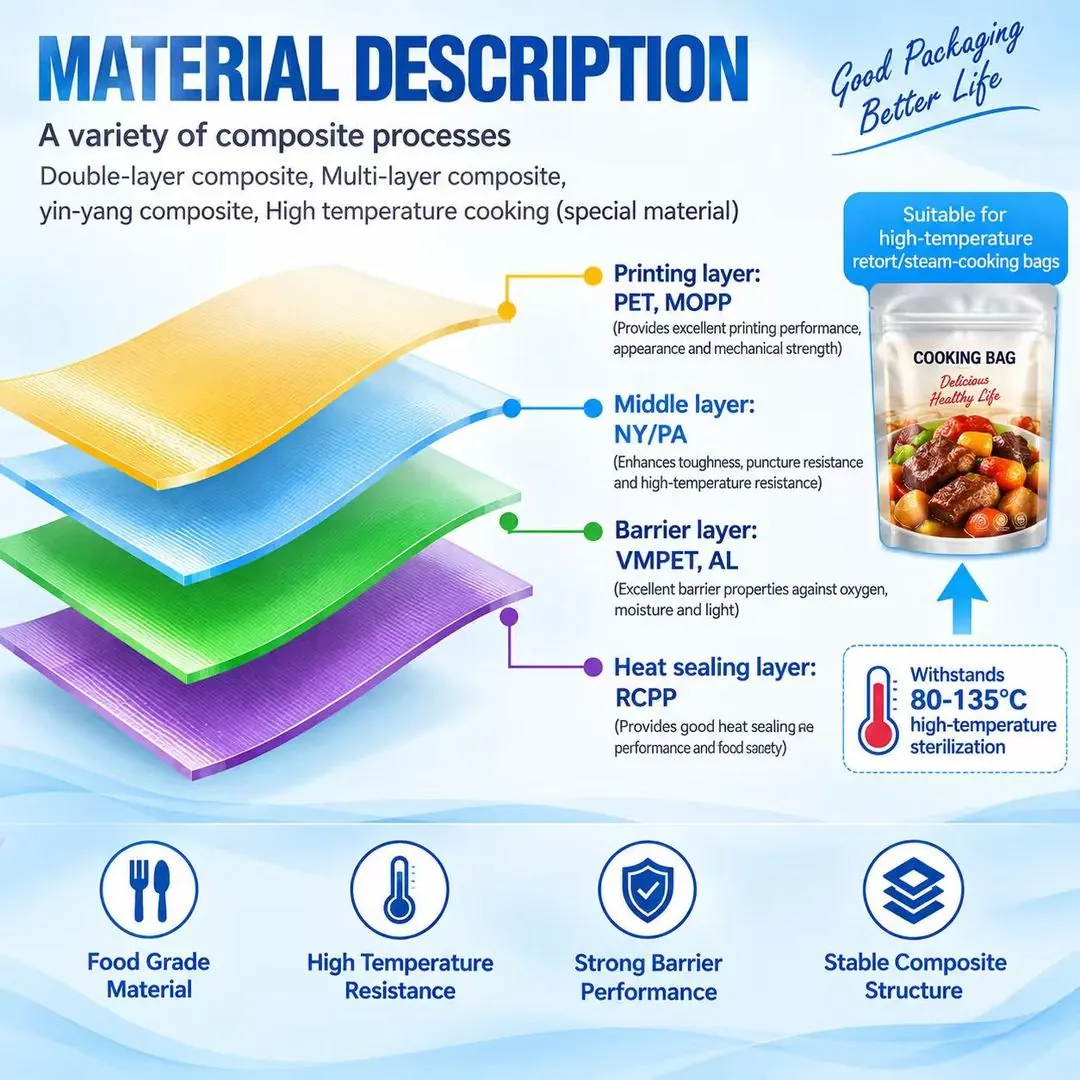
That is why a retort pouch is a four-layer sandwich, and why every layer has one job:
- PET (polyester), outer layer. The print surface. It holds fine rotogravure print detail through handling and keeps artwork from scuffing in distribution.
- NY (nylon), puncture guard. Nylon gives the pouch its flex-crack resistance — the repeated creasing at corners and folds that opens micro-leaks during retort and transport.
- Aluminium foil, barrier core. Oxygen and water vapour transmission drop to near zero and light is blocked completely. This is the layer that makes a 12–24 month ambient shelf life realistic.
- RCPP, retort sealant. Retort-grade cast polypropylene is the inner sealing layer. Ordinary polyethylene — the sealant in most everyday food pouches — softens well below retort temperature. Swap it in and the pouch looks fine on filling day, then fails at the seal weeks later. This single substitution is the most common shortcut we see when buyers compare quotes.
Aluminium foil is the default barrier core, but not the only option. If you need a metal-free pack for metal-detection lines, or a transparent window so shoppers can see the product, high-barrier transparent structures built on EVOH or coated films are available. They cost more and their barrier is lower than foil, so your target shelf life decides whether the trade works.
What actually happens inside a microwave cooking bag
A microwave cooking bag — you will also see “microwavable pouch” or “microwave-safe steaming bag” — is built around a completely different moment: the customer takes the pack from the freezer and puts it, still sealed, into the microwave. No opening, no plate, no cling film over the top.
As the food heats, water turns to steam and pressure inside the pack climbs fast. A fully sealed pouch relieves that pressure by bursting — usually at a seal corner, usually over the inside of a clean microwave, and always at the customer’s expense. The fix is a venting feature engineered into the pack: a pressure-release point that opens progressively as internal pressure builds, releasing excess steam while the food keeps heating in its own moisture. After heating, the pack is torn or cut open and served.
Brands adopt the format for four practical reasons:
- Convenience. Freezer to table in one pack, no dish to wash, no guesswork on timing.
- Texture. Steam heating keeps dumplings, buns and rice moist in a way that a plate under plastic film does not.
- Fewer components. No separate steam tray, no printed venting instructions, no lid to peel.
- Portion control. Single-serve packs for food service and convenience retail.
One caution: “microwave-safe” on a spec sheet is not a venting design. A plain polyethylene pouch that survives sixty seconds in a microwave is not the same as a pack engineered to vent predictably across a range of fill weights and microwave powers. Ask to see the venting demonstrated — a sealed bag going straight into a microwave is a two-minute test, and we run it on camera for exactly that reason.
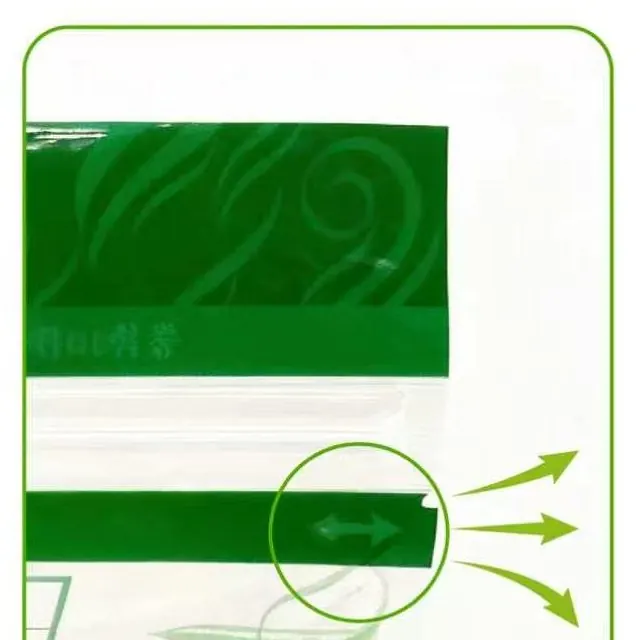
Both formats live or die at the seal
Whichever format you buy, the seal is where packs fail. Three things decide whether it holds:
- Seal width. Narrow seals cost less per pack and fail sooner. For retort, the seal has to hold through pressure cycling, not just sit on a shelf.
- Seal parameters on the filling line. Temperature, pressure and dwell time must be matched to the sealant layer. The same film on two filling lines can produce different results if the parameters drift.
- Clean seal zones. Product in the seal area — a drop of sauce, a crumb of frozen dough — creates a channel leak that no sealing pressure fixes. Fill height and product viscosity matter as much as film quality here.
What to specify before you ask for a quote
Quotes for “a retort pouch” can vary by a factor of two depending on assumptions the supplier had to make. Answer these points in your inquiry and the numbers that come back will be comparable:
| Specification | Why it changes the quote |
|---|---|
| Product chemistry — pH, water activity, fat, salt, particle size, bones | Acidic and high-fat products attack some adhesives and films; bones puncture |
| Thermal process — retort profile (121°C or 135°C, time) or microwave use | Decides the sealant layer and whether a venting structure is needed |
| Target shelf life — 6, 12, 18 or 24 months ambient | Decides the barrier: foil, EVOH or clear high-barrier |
| Format and size — flat, stand-up, side-gusset, spouted; fill weight | Changes tooling, film width and price per piece |
| Filling method — automatic line or hand fill; seal bar width | Seal design must match your line’s parameters |
| Print — colours, coverage, finish (matte, gloss, soft-touch) | Rotogravure cylinders are quoted per design; coverage drives ink cost |
| Destination market — FDA or EU food-contact, migration testing | Compliance documentation has to match the destination |
| Order quantity and launch timing | MOQ for functional pouches starts at 5,000 pcs; cylinders add lead time |
MOQ, samples and lead time
Functional pouches — retort and microwave — carry a higher minimum than standard pouches, and it helps to know why before comparing suppliers: the RCPP sealant film and high-barrier laminates are produced in long mill runs, and every new structure has to pass retort validation before it goes into production.
| Item | Typical terms |
|---|---|
| Stock samples | Free — you cover the courier cost |
| Customized printed proof (1–2 pcs) | US$120, including artwork setup |
| Colour-matching proof film | Free |
| MOQ — standard pouches | 100–500 pcs |
| MOQ — functional pouches (retort / microwave) | 5,000 pcs |
| Customized sample lead time | 5–7 days after artwork is confirmed |
Five questions worth asking any supplier
- Which structure are you quoting, and why that sealant? If the answer is not RCPP for retort, ask what happens at 121°C.
- What retort profile has this structure been validated at? A structure is not “retort-grade” in general — it is validated at a specific temperature and time.
- Can I see test results — seal strength, burst, and a boil or retort test on video? Any factory that runs the tests will have the footage.
- Which certificates cover the food-contact layer, and for which markets? Ask for FDA and EU food-contact documentation, not just a factory certificate.
- Who runs the first production validation, and what happens if it fails? You want the answer to be the factory, on their own line, before your goods ship.
For the wider checklist — audits, references, trade assurance — see our guide How to Vet a Customized Pouch Manufacturer.
Where we come in
We manufacture both formats on the same floor: retort pouches in PET/NY/Al/RCPP for 121°C and 135°C cycles, and proprietary self-venting microwave-ready bags that go straight from freezer to microwave. Both are built to specification with up to 10-colour rotogravure print and FDA and EU food-contact compliant materials. See the ranges on the retort bags page and the microwave-ready bags page — including the dedicated microwave venting pouch — or send us your product, process and fill weight and we will come back with a structure and a price. Full details are on the contact page.
Frequently asked questions
What is the difference between a retort pouch and a microwave cooking bag?
A retort pouch is sterilized after sealing in a steam-pressure vessel, usually at 121°C or 135°C, which makes the food shelf-stable at room temperature for months. A microwave cooking bag is not sterilized — it is designed so the consumer heats the food in the sealed pack, with an engineered vent releasing steam so the pouch does not burst.
Can a retort pouch be microwaved?
It depends on the structure. Pouches with an aluminium foil barrier layer must not go into a microwave — metal reflects microwaves. Foil-free transparent retort structures can be microwaved once the pack is opened or vented. If microwave reheating is part of your product concept, say so at the specification stage and a foil-free structure can be quoted.
How long does food last in a retort pouch?
With a foil barrier core, 12–24 months at ambient temperature is a realistic target for most products. Transparent high-barrier structures deliver less. The exact figure should come from stability testing on your own product, not from the packaging supplier alone.
What is the MOQ for customized retort pouches?
Functional pouches such as retort and microwave bags typically start at 5,000 pieces, because the retort-grade sealant film is produced in long mill runs and every structure has to pass validation before production. Standard non-retort pouches can be ordered from 100–500 pieces.
Are microwave cooking bags safe if they stay sealed during heating?
Yes — that is the design. The engineered vent releases excess steam progressively while the pack stays closed, so the food heats in its own moisture and nothing bursts. The pack is opened only after heating, along the tear line.
Where can I buy retort pouches in small quantities?
Most factories quote retort pouches from 5,000 pieces because of the sealant film minimum run. The practical path for small brands is free stock samples first, then a short customized printed proof run to test the market before committing to the production order.
Related reading
Related: Retort and microwave bags
Need retort or microwave pouches quoted to spec?
Retort pouches for 121°C and 135°C cycles, proprietary self-venting microwave-ready bags, 10-colour rotogravure print, FDA and EU food-contact compliant. Send your product, process and fill weight for a structure and price.