
Blog
Stand-Up vs Flat-Bottom vs Side-Gusset: Which Pouch Format Fits Your Product?
Most buyers arrive at a pouch factory with a structure question — barrier, thickness, shelf life — and leave having learned that the format decision matters just as much. The format decides how the pack stands on a shelf, how it runs on your filling machine, how much film each unit consumes and, quietly, a large share of the unit cost. It is also the hardest thing to change later, because printing cylinders are cut for one specific layout.
This guide compares the five formats we run every day, from the factory floor's point of view: what each is genuinely good at, what it costs you, and the shortcuts for deciding. If you want the deep spec on any single format, each has its own page linked below.
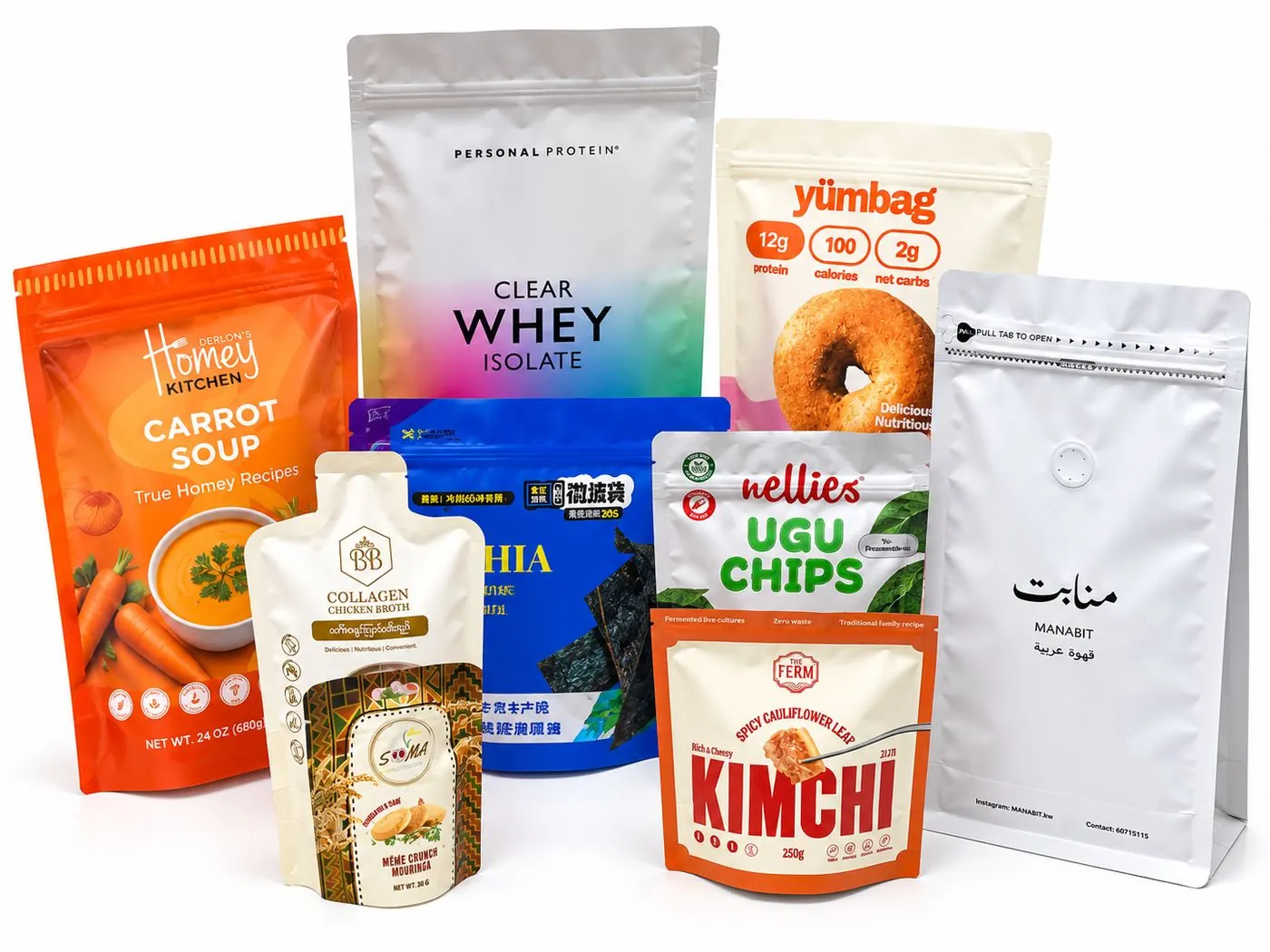
Stand-up pouches: the retail workhorse
A stand-up pouch holds itself upright on a shaped bottom gusset, presents a flat front and back panel, and takes every closure in the catalog: zippers, degassing valves, hang holes, tear notches, laser scoring. It is the default for a reason — cheap to make, cheap to ship flat, and it merchandises well from 50 g sample sizes up to a couple of kilograms.
Where it is less ideal: very heavy, dense products (large-format pet food) push a stand-up base to its stability limit, and ultra-premium shelf presentations often want more printable real estate than two panels give. For most food brands between those extremes, this is the right first answer. Full specs on the stand-up pouches page.
Flat-bottom pouches: the premium shelf player
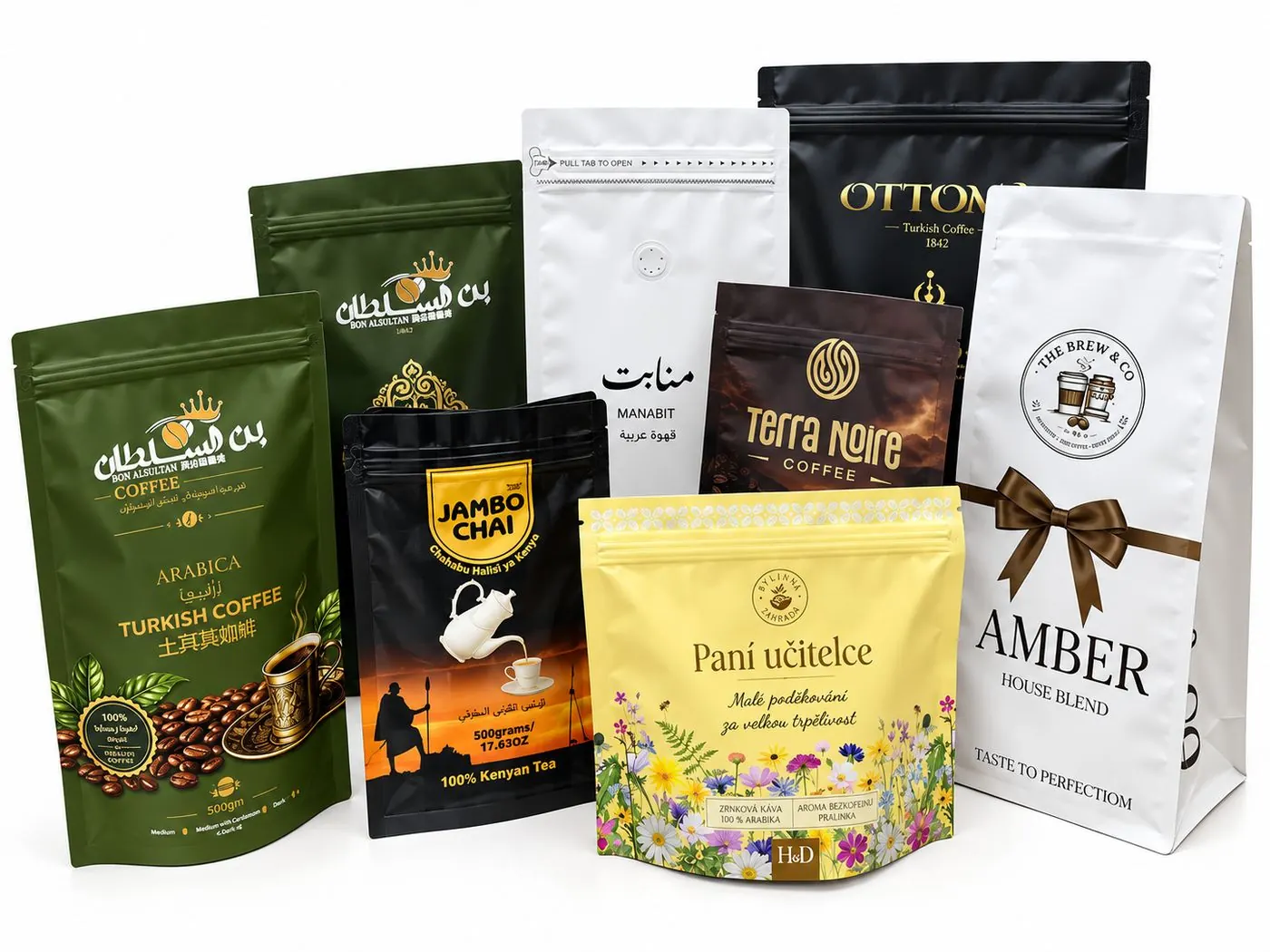
A flat-bottom (box-bottom) pouch stands on a rectangular base, which buys you five printable panels — front, back, two sides and base — and a brick-like silhouette that reads premium on a shelf. The base also carries weight exceptionally well, which is why flat-bottom is the natural home for 2–5 kg pet food packs and premium coffee.
The trade-offs are honest ones: it consumes more film per unit than a stand-up pouch of the same volume, and converting is more involved, so unit cost runs higher. You are paying for shelf presence and weight capacity — if either matters commercially, it is usually worth it. Details on the flat-bottom pouches page.
Side-gusset bags: the coffee classic
The side-gusset bag is the traditional coffee and tea format: gussets fold inward at the sides, the base folds flat, and the top seals after filling. It uses film efficiently, runs fast on filling lines, and takes a degassing valve and tin-tie naturally — roasters have packed it for decades for good reasons.
Its shape is more cylindrical than billboard-like, so front-panel impact is softer than a stand-up or flat-bottom pouch, and loose-filled bags can lean. Coffee brands accept this for the economics and the format's familiarity on the shelf. Specs on the side-gusset bags page.
Three-side-seal pouches: the low-cost specialist
Seal the left, right and top of a flat laminate and you have the three-side-seal pouch: a flat sachet with no gussets and no stand. It is the lowest cost per unit in the lineup and the fastest to make, which is exactly why single-serve portions, sample sachets, wet wipes and test-size packs live here.
It does not merchandise standing, so it lives on clip strips, in multipacks, or inside cartons. If your product is a one-use portion, this format deserves a look before anything fancier. See the three-side-seal pouches page.
Spouted pouches: when the product pours
A spouted pouch is a stand-up pouch with a fitment — screw cap or flip top — bonded through a film opening. It turns a flexible pack into a pourable one: drinks, purées, detergents, refills of every kind. The value case is brutal and simple: a spout pouch ships flat and weighs a fraction of a rigid bottle, and brands increasingly use refill spout packs to cut the plastic footprint of their rigid lines.
The costs are fitment price and fitment application — inserting and heat-sealing a spout is an extra converting step, and filling lines for spouted packs are more specialized. When the product is liquid and the volume is real, the math still lands on the pouch's side. Details on the spouted pouches page.
The side-by-side comparison
| Format | Stands alone? | Shelf presence | Typical fills | Relative unit cost | Best for |
|---|---|---|---|---|---|
| Stand-up pouch | Yes | Strong two-panel front | 50 g – 2 kg | Low–medium | Snacks, coffee, powders — the default |
| Flat-bottom pouch | Yes, very stable | Five panels, premium look | 250 g – 5 kg | Medium–high | Premium coffee, large pet food, gift packs |
| Side-gusset bag | With support / clip | Traditional, compact | 100 g – 1 kg | Low | Coffee and tea with valves and tin-ties |
| Three-side-seal | No (flat sachet) | On clips / in multipacks | 1 g – 100 g | Lowest | Single-serve, samples, wet wipes |
| Spouted pouch | Yes | Functional, modern | 100 ml – 2 L | Higher (fitment) | Liquids, purées, refills |
Costs are relative within the lineup and shift with volume, structure and closures — treat the table as a decision aid, not a quote.
Your filling machine gets a vote
Before falling in love with a format, ask who fills it. Buyers running VFFS machines buy laminated roll film and form the pouch on the line — the machine model dictates which formats are even possible. Buyers using pre-made pouches (fill-and-seal machines or co-packers) can choose any format but should confirm the bag's dimensions and gusset against the machine's magazine and grippers. A format the line cannot run is not a format; it is a sample. Our roll film page covers the VFFS side in detail.
Closures and add-ons change the answer
Formats and accessories are a matrix, not a menu: zippers, degassing valves, hang holes, tear notches, windows, die-cut shapes and spouts each combine differently with each format. Two quick examples from real projects: a hang hole turns a stand-up pouch into a peg-board SKU; a die-cut shape plus a window turns a flat-bottom into a gift pack. The full set lives on the customized service page.
The four-question shortcut
- How much does it weigh? Under ~2 kg and dry: stand-up. Over 2 kg or dense: flat-bottom. Liquid: spouted.
- Where does it sell? Retail shelf: stand-up or flat-bottom. On-clip or in-box: three-side-seal. Coffee aisle: side-gusset or flat-bottom.
- How is it filled? VFFS roll film, pre-made pouch machine, or by hand — confirm with your co-packer before choosing.
- What does the brand need to say? Two panels, five panels or a cylinder — pick the canvas the story needs, then reconcile with budget.
Answer those four and one format usually separates itself from the pack. Send us the answers and we will confirm it with a structure proposal and a physical sample — because the last word always belongs to the product, not the spreadsheet.
Frequently asked questions
Which pouch format is the cheapest?
For small fills, the three-side-seal sachet has the lowest unit cost — least film, fastest converting. Among self-standing formats, side-gusset and stand-up pouches are the most economical; flat-bottom carries a premium for its base construction and extra panels. Unit cost also depends heavily on structure and quantity, so treat format as one lever among three.
Can a flat-bottom pouch also have a zipper and a degassing valve?
Yes — zipper, valve, tin-tie, hang hole and tear notch all work on flat-bottom construction. The correct way to plan it is on the dieline: closure positions are fixed before the design is built around them, which is why we issue the dieline first.
What format should I use for a 3 kg pet food pack?
Flat-bottom is the natural choice at that weight: the rectangular base carries load stably and the panels hold the feeding-guide information large packs need. Heavy-duty stand-up constructions exist too — with reinforced structures they work well up to around 2 kg, beyond which flat-bottom earns its cost.
Is the MOQ different for each format?
For digitally printed stock-size pouches our MOQ starts at 100–500 pieces across common formats. Functional or custom-fitment packs — spouted pouches, retort grades, microwave constructions — start around 5,000 pieces, because fitment application and structure validation are batch processes. Ask us per project; a specific size or fitment may move the number.
Can I switch formats later without redoing everything?
The structure and print assets carry over, but the artwork does not: cylinders are engraved for one specific format layout, so a format change means new dieline, re-laid artwork and new cylinders. That is why we push the format decision hard before artwork starts — and why we quote the reorder economics for your top two formats before you commit.
Related reading
Related: All pouch formats
Not sure which format fits your product?
Tell us the product, fill weight and how it will be filled — we compare the two best-fit formats on structure, sample and price so you can decide on facts, not guesses.