
Blog
One-Way Valve Coffee Bags: Do You Actually Need One?
A roaster packs a fresh batch on Tuesday, ships it on Wednesday, and gets an email on Friday: “the bags arrived puffed up like balloons.” That is not a defect. It is carbon dioxide — roughly one litre of it per kilogram of coffee in the first days after roasting — escaping from beans that are still very much alive. The bag is doing what a sealed barrier must do: holding that gas in. Without somewhere for it to go, it pushes at the seams until one gives way.
Threads asking about this resurface constantly on r/roasting and r/Coffee, and the answers split two ways: “you absolutely need a valve” and “a valve is a marketing gimmick.” Both are wrong, and it is worth a few minutes to see why, because the answer decides a real line item on your packaging invoice.
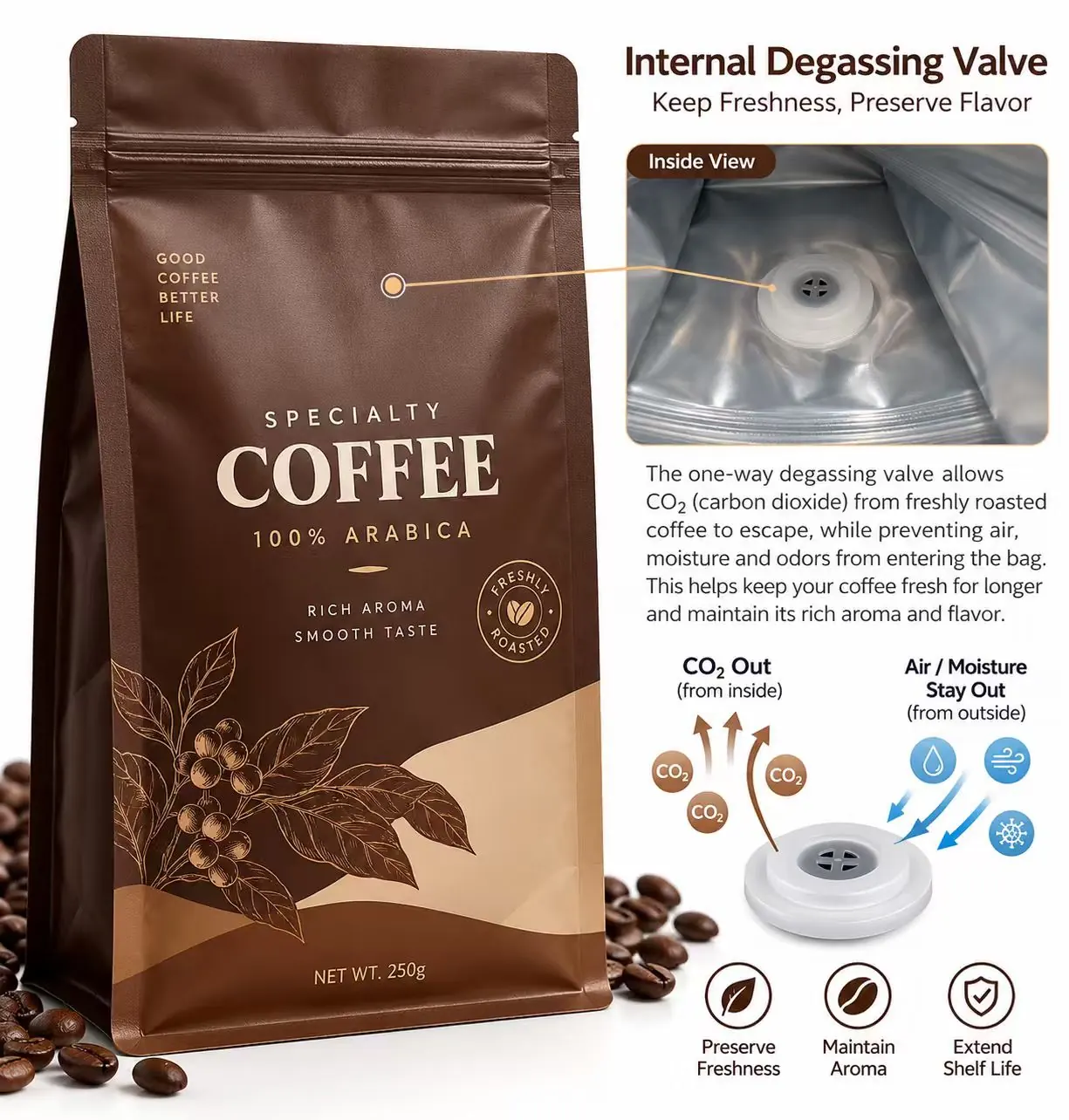
What a degassing valve actually does
A one-way valve (also called a degassing valve, or fresh valve bag in some markets) is a small adhesive patch with a silicone membrane inside. When pressure inside the bag climbs above the opening threshold — typically around 2–5 kPa — the membrane lifts and lets gas out. When internal and external pressure equalise, it reseals. Air cannot travel the other way, and neither can the aroma compounds that carry most of what you taste in the cup.
The result is a bag that finds its own equilibrium. It does not balloon in transit, it does not need to be packed with slack air, and the beans inside are not wrapped in a cushion of oxygen the way they would be in a fully sealed bag that was flushed with nitrogen.
What it does not do: a valve does not make coffee fresh, does not preserve coffee forever, and does not replace a proper barrier film. It solves one specific problem — pressure management. Everything else is still down to your material structure, your seal integrity, and your roast date discipline.
Valve patch, valve sticker, stick-on valve: three names for the same part
If you have been searching for a "valve sticker" or a "stick-on valve", you have already found the right part. Suppliers and roasters call the same component at least four ways — one-way degassing valve, valve patch, valve sticker and stick-on valve — and the catalogues do not agree on one of them. They are all the same thing: a small patch carrying a silicone membrane, seated over a hole punched in the pouch, with gas going out and oxygen staying out.
The distinction that actually matters is not the name but who applies it and to what:
- Fitted to the pouch at the factory — the valve is applied by an applicator that heat-seals the patch onto a flat area of the bag. This is how valve coffee bags are normally bought, and it is how every order we have shipped has been built.
- Supplied loose, for you to apply — the valves arrive as parts and you or your co-packer fit them. This is a real category of product, but it is not what we do: every pouch we ship leaves the factory with the valve already fitted.
The reason is the application step. The heat-seal that seats the valve has to suit both the film and the valve body: too much heat or dwell and the valve base warps out of flat, and a valve that is no longer flat leaks pressure rather than venting it. A valve fitted in the same plant that made the pouch can be checked against that pouch before it ships; a valve fitted somewhere else cannot.
So the practical answer for anyone searching “valve sticker” is: you are looking for the right part, and you will almost certainly buy it already fitted to the bag. Specify the valve on the pouch order and the valve, the hole position and the seal around it are all set by the plant that makes the pouch — which is the only way the combination gets tested before it ships. We do not sell valves as loose parts, and we do not retrofit valves onto bags made elsewhere; the valve is quoted and built as part of the pouch.
Do you need one? Three honest cases
Case 1 — You roast and pack within 7 days: yes, you need one
This is the textbook case. Fresh-roasted coffee keeps producing CO₂ for roughly 7 to 10 days, with most of it released in the first 48 hours. Packed quickly and shipped fast, the bag will take on real pressure, and a sealed bag will either puff, distort, or fail at a seam. A valve lets that gas out while the barrier keeps oxygen out.
Case 2 — You roast and pack after full degassing: often not, but the maths still favours it
Some roasters rest beans in open bins for a week before packing. If the CO₂ is already gone, the pressure problem largely disappears. This is where the r/Coffee cost argument comes from: one commenter put it at roughly $0.40 for a plain bag versus $0.80 for a valve bag — and questioned whether the extra forty cents buys anything.
It buys three things, and you get to decide if they are worth it to you: tolerance for imperfect packing discipline, resilience to temperature swings in a shipping container, and a customer-facing signal that the product is gas-fresh rather than warehouse-aged. For a brand selling by roast date, that last one is not nothing.
Case 3 — You sell coffee in a valved bag but never re-seal it properly: the valve covers a bigger problem
If customers open the bag daily and never press the zipper shut, the valve's benefit is marginal compared with the oxygen entering through the open top. Fix the closure story first — a working resealable zipper, and a note telling buyers to squeeze the air out before sealing. The gist tape is the cheapest freshness tool you own.
“Valve vs no valve” is the wrong question — ask this instead
The question that actually governs shelf life is not whether there is a valve. It is how much oxygen reaches the beans, and how much light. A three-layer bag with a valve and an oxygen barrier will outperform a cheap single-layer bag with a valve every time. Rather than asking whether to add a valve, ask what your bag's barrier does about oxygen and light, and what a valve on top of that gives you.
| Your situation | Recommendation | Why |
|---|---|---|
| Packing within 3–5 days of roast, shipping by post or courier | Valve + barrier film (e.g. PET/AL/PE or metallized PET/PE) | Gas must escape; seam failure in transit is the main risk |
| Packing after 7–10 days of resting | Valve optional — barrier film is non-negotiable | Little CO₂ left, but oxygen and light still destroy aroma |
| Retail shelf, brand selling by roast date | Valve + zipper + matte or soft-touch finish | Shelf signal and repeated opening both matter |
| Coffee capsules or pods, seal-stable | No valve needed | Not a degassing package |
What a valve adds to the price
Be careful with the $0.40-versus-$0.80 comparison above: it is a consumer's sample of two retail bags, not factory pricing. At factory level, a degassing valve is an applied patch — valve plus adhesive patch, positioned on the film before the bag is made — and its cost is a small fraction of the finished pouch. What moves the needle more is everything around it: your film structure, your print method, and your quantity.
Two practical notes that surprise buyers:
- Valve placement is a specification, not a detail. On a side-gusset bag the valve normally goes on the front panel clear of the fill zone; on a stand-up pouch it goes high on the front, above the zipper. Put it where the filling machine or the customer's thumb will fight it and you will regret it.
- Valve + valve patch are quoted together. If a supplier quotes a valve without saying which patch and which placement, ask — that is where rework happens.

Five packaging mistakes that cancel out your valve
- No barrier in the film. A clear mono-layer bag with a valve is a colander with a tap. Oxygen and light pass straight through; the valve does nothing about either.
- Packing too hot. Bags filled immediately off the roaster trap moisture and volatile compounds you want to lose. Rest for at least a few hours, longer for darker roasts.
- Over-filling above the valve. Beans packed against the membrane block it. Leave headspace, and keep the valve clear of the product level when the bag stands.
- Sealing through the valve patch. A crimp across the patch creates a leak path. Set the fill height so the seal bar never crosses the valve.
- Assuming the valve keeps coffee fresh for months. Whole-bean coffee is at its best in the first 2–6 weeks. The valve protects the window; it does not extend it indefinitely.
What to ask a supplier before you order valve bags
Four questions separate a good valve-bag order from a rework:
- Which valve and which patch? Valve brand or type, patch size, and the film it is applied to.
- Where will it be placed on my format? Ask for a drawing or a sample with the position marked, measured from the seal edge.
- Has this structure been tested with coffee? Oxygen transmission rate for the film, and whether they have run coffee before — coffee oil is aggressive against some inks and adhesives.
- Can I get a physical sample with the valve applied? Never approve a valve placement from a digital proof alone.
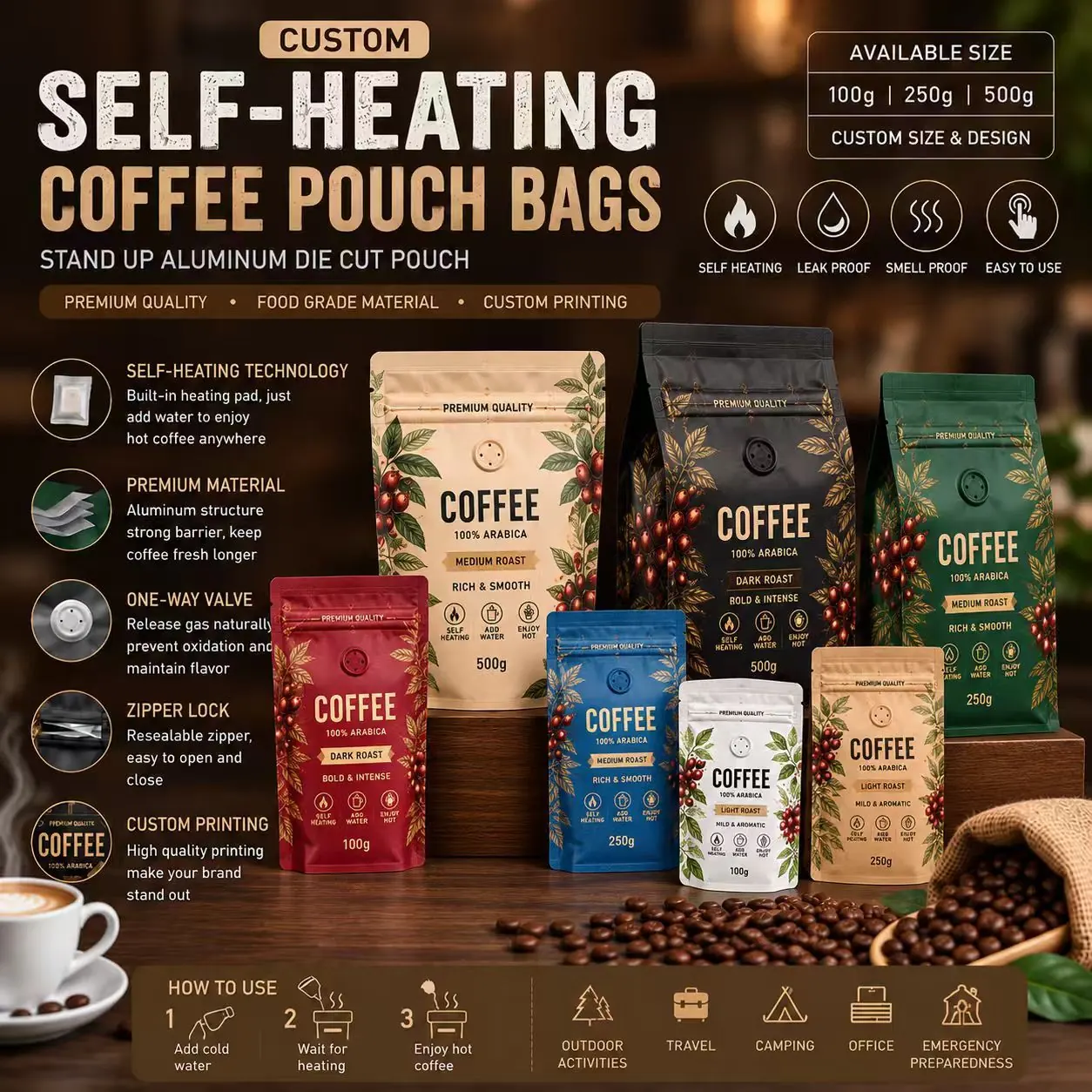
We build valve coffee bags in side-gusset, flat-bottom and stand-up formats, with metallized or tinted barriers, optional zippers, and the valve positioned to suit your fill line — up to 10-colour rotogravure or flexographic print. If you send us your roast volume, bag size and filling method, we will come back with a structure and a valve placement drawing. See the full range on the coffee bags page, or ask us anything on the contact page.
Frequently asked questions
Can I buy the valves on their own, without the bags?
No. Valves are supplied already fitted to the pouches we make, not as loose parts. The applicator heat-seal has to suit both the film and the valve body — too much heat or dwell warps the base out of flat, and a valve that is not flat leaks instead of venting. We also do not retrofit valves onto bags made elsewhere: the valve is quoted and built as part of the pouch, so the combination can be tested before it ships.
What is a one-way valve coffee bag?
A one-way valve coffee bag is a barrier pouch fitted with a small adhesive valve patch. The silicone membrane inside lets carbon dioxide escape as freshly roasted beans degas, then reseals so outside oxygen cannot travel back in. In the trade the same component is also called a degassing valve bag or fresh valve bag — it is one part, not a special bag format.
Is a degassing valve necessary for coffee bags?
If you pack within about 5 days of roasting and ship the coffee, yes — the bag will build real pressure and a sealed bag risks seam failure or distortion in transit. If your coffee has already rested 7–10 days before packing, a valve is optional, though most brands still fit one for transit safety and shelf signal.
Does a valve let oxygen in and make the coffee stale faster?
No. A degassing valve is one-way by design: the silicone membrane opens outward under internal pressure and reseals when pressures equalise, so outside air does not travel back in. In practice a valved bag with a good oxygen barrier keeps coffee fresher than a plain sealed bag that had to trap its own CO₂.
Do valves degrade or need replacing?
As a single-use component, a valve is engineered to stay reliable for the life of the pack — typically 12 months or more in normal storage. r/Coffee has a thread on reusing valves salvaged from old bags; our view is that the valve itself may still work but a re-used patch will not hold its seal, so do not build a process on it.
Should coffee be packed with nitrogen if the bag has a valve?
Nitrogen flushing replaces oxygen with an inert gas, which slows staling — but freshly roasted beans will still push out CO₂ and displace it within days, which is exactly why a valve is fitted. Flushing makes most sense for ground coffee or for pre-degassed beans where you are preserving a stable state rather than managing an active one.
What size valve should I choose?
Valve size follows bag size and fill weight. Small 250–340 g pouches usually take a small standard valve patch; 1 kg and larger bags, or bags filled hot, need a higher-flow valve. Send us your bag dimensions and fill weight and we will specify it — a valve that is too small for the volume is a common cause of “slow-puffing” bags.
Related reading
Related: Customized coffee bags
Need valve coffee bags built to your roast?
Side-gusset, flat-bottom and stand-up formats with one-way degassing valves, metallized or tinted barriers, and valve placement matched to your fill line. Send your bag size and roast volume for a structure and price.