
Customized Stand-Up Pouches
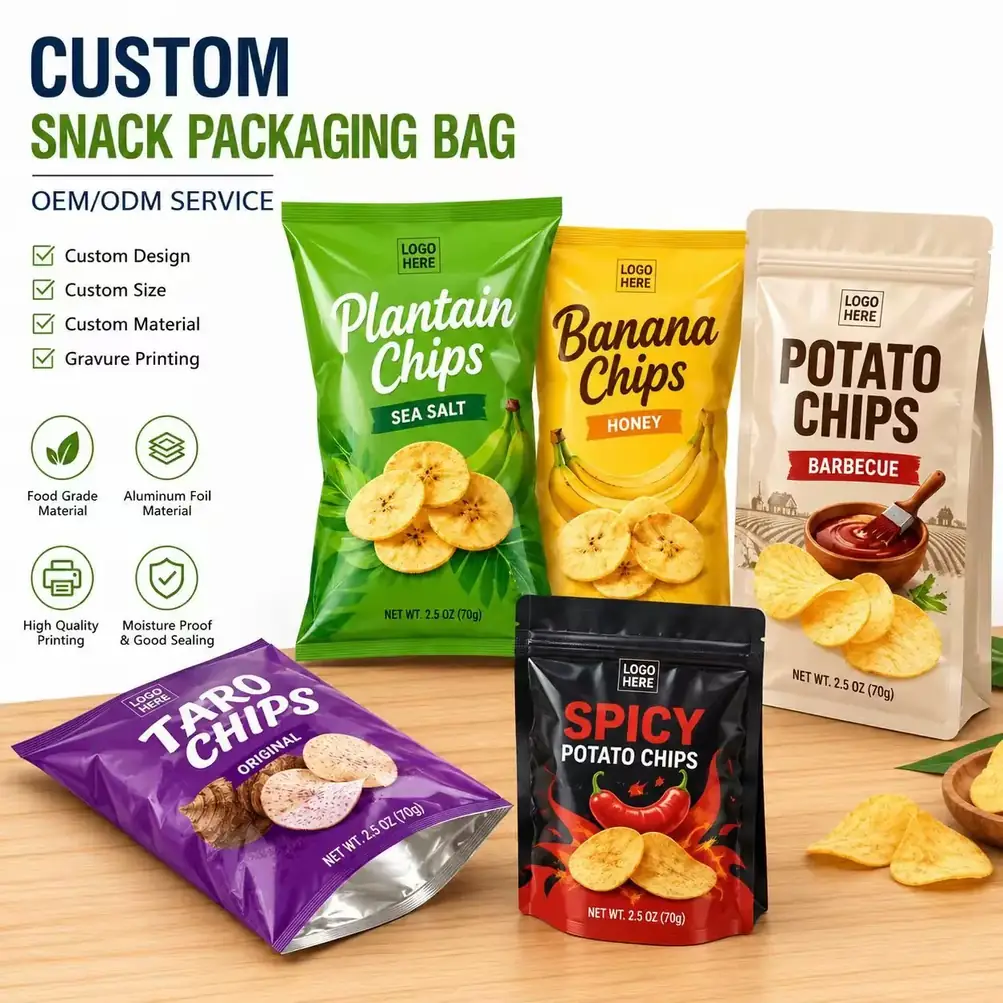
Stand-up pouches are the most widely used retail format in flexible packaging — a gusseted base lets the pack stand on shelf by itself, while a multi-layer laminate protects the contents from moisture, oxygen and light. We print and convert them to your artwork from 100 pieces per design.
Key Features
- Gusseted base — stands upright on shelf without a support
- Multi-layer laminate matched to your barrier and fill weight
- Zipper, valve, window, hang hole and tear-notch options
- Up to 10-colour printing with matte, gloss or kraft-look finishes
Key Takeaways
Stand-Up Pouches at a Glance
- A stand-up pouch typically uses far less material than a rigid jar, tin or bottle holding the same volume, and it ships flat before filling.
- Standard MOQ is 100–500 pcs per design — low enough for a first run, a test market or a rebrand.
- Structure drives performance: PET/PE for dry goods, PET/VMPET/PE for aroma and light protection, PET/AL/PE for the longest shelf life.
- Zippers, degassing valves, spouts and windows are added in-line, so one supplier handles the entire pack.
- Customized printed samples take 5–7 days; stock samples are free apart from freight.
Format
When a Stand-Up Pouch Is the Right Choice
A stand-up pouch earns its place when the pack has to sell itself on a crowded shelf and still survive transport, storage and repeated opening. The bottom gusset unfolds into a flat base, so the pouch stands upright in a retail display, on a kitchen counter or in a cupboard — something a flat pillow bag cannot do.
It also covers an unusually wide fill range. The same format works for 50 g of seasoning and 2 kg of pet food; only the dimensions, film thickness and closure change. That flexibility is why stand-up pouches now dominate snacks, coffee, pet treats, dried fruit, nuts, powders and ready-to-eat foods.
If your product needs to stand, reseal and be re-used, start here. If you are packing a liquid or paste, look at spouted pouches instead. If the filled pack is sterilized, the retort range is the correct starting point.
Specifications
Build Options
| Item | Standard options |
|---|---|
| Material structure | PET/PE · PET/VMPET/PE · PET/AL/PE · kraft paper/PE · recyclable mono-material PE |
| Total thickness | Typically 80–160 micron, specified against your fill weight and barrier target |
| Sizes | Stock sizes from 50 g to 2 kg, plus fully customized dimensions from your dieline or sample |
| Printing | Rotogravure and flexographic, up to 10 colours; matte, gloss, soft-touch or kraft-look finish |
| Closures | Resealable zipper, one-way degassing valve, spout, tear notch, hang hole, round corners |
| Surface options | Clear window, spot varnish, cold-foil accents |
| MOQ | 100–500 pcs per design for standard structures; 5,000 pcs for functional or retort-grade builds |
| Customized samples | 5–7 days · US$120 for 1–2 pcs · print film fee waived |
| Compliance | FDA 21 CFR and EU 10/2011 food-contact reports; produced under BRCGS Issue 7 (Grade B) |
Not sure which structure fits your product? Send the fill weight, shelf life and storage conditions and we will propose two or three options with the trade-offs spelled out.
Comparison
Stand-Up vs. Flat-Bottom vs. Flat Pouch
| Stand-up pouch | Flat-bottom pouch | Flat (pillow) pouch | |
|---|---|---|---|
| Shelf presence | Good — gusseted base stands on shelf | Best — five printable panels | None — needs a tray or a hanging strip |
| Fill range | 50 g – 2 kg | 200 g – 5 kg | 10 g – 1 kg |
| Print area | Two faces plus base | Front, back, two sides and base | Two faces |
| Typical uses | Snacks, coffee, powders, pet treats | Premium coffee, protein, pet food | Single-serve, bars, samples |
| Relative cost | Baseline | Highest of the three | Lowest of the three |
Applications
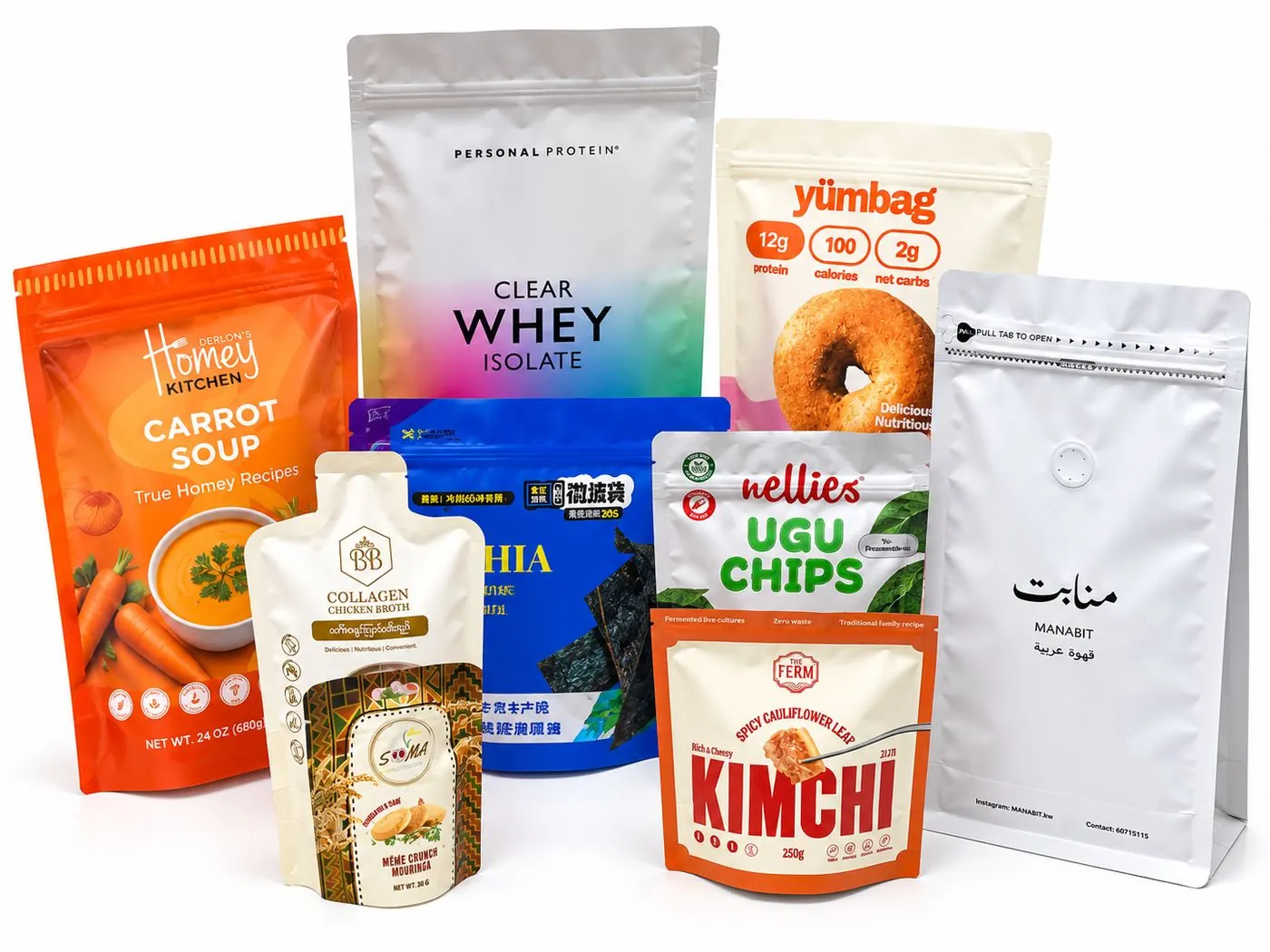
What Stand-Up Pouches Are Used For
Dry snacks & confectionery
Chips, nuts, dried fruit, candy and trail mix — a metallized barrier keeps contents crisp and keeps light out.
Coffee & tea
250 g to 1 kg packs with an optional one-way valve and zipper for roasters and private-label brands.
Pet treats & dry food
Puncture-resistant structures with wide resealable zippers for repeat use.
Powders & dry mixes
Protein, spices, flour blends and drink mixes — with a hang hole or flat base for shelf display.
Frozen foods
Low-temperature laminates that stay flexible without cracking at frozen storage temperatures.
Home & pet care
Granules and treats where a sturdy, printable pouch replaces a rigid container.
Process
From Enquiry to Delivery
Send your spec
Fill weight, product type, shelf life, and any barrier or compliance requirement.
Structure proposal
We reply with two or three laminate options, the MOQ and an indicative unit price.
Artwork & proof
You supply artwork or a dieline; we return a print proof for your sign-off.
Sample run
Customized samples in 5–7 days so you can fill, seal and test before committing.
Production
Print, laminate, cure, slit and bag-make in-house on 10 production lines.
Inspection & shipping
In-line and final inspection, then export packing and shipping documents.
Printing
Printing and Finishing
Artwork is printed on rotogravure or flexographic presses in up to ten colours, so gradients, photography and brand colours hold up across the whole run. Cylinder costs are quoted once and reused on repeat orders, and the print film fee is waived on colour-matching orders.
Finishing is where a pouch becomes a pack: zippers and valves are applied in-line, windows are left unprinted, tear notches and hang holes are punched, and the film is slit and converted into finished pouches. Matte, gloss, soft-touch and kraft-look finishes can be mixed within one order.
If your product is sensitive to oxygen or light, raise it at the quotation stage. The difference between a metallized layer and an aluminium foil layer is significant, and it is far cheaper to specify correctly the first time than to reformulate after a shelf-life failure.
FAQ
Stand-Up Pouches — Common Questions
What is the minimum order for customized stand-up pouches?
100–500 pcs per design for standard structures. Functional builds such as high-barrier or retort-grade laminates start at 5,000 pcs, because the film specification and printing setup cost more to run.
Which material structure should I choose?
PET/PE covers dry goods with a short shelf life. Adding a metallized layer (VMPET) brings aroma, light and oxygen protection — the usual choice for coffee, nuts and snacks. Aluminium foil (AL) gives the longest shelf life, and mono-material PE is the option when recyclability is the priority.
Can a stand-up pouch have both a zipper and a valve?
Yes. Combining a resealable zipper with a one-way degassing valve is standard for coffee: the valve releases carbon dioxide without letting oxygen in, and the zipper keeps the contents fresh after opening.
Can I see stock samples before ordering a printed run?
Yes. Stock samples are free — you only cover the freight. Printed samples made to your artwork take 5–7 days at US$120 for one to two pieces, with the print film fee waived.
What information do you need to quote?
Fill weight or volume, product type, required shelf life, storage conditions, target dimensions, closure requirements and any compliance or certification the pack must meet. A dieline or an existing sample speeds this up considerably.
Where are the pouches made?
In our own factory in Huizhou, China — 10 production lines and 100+ workers, operating under a BRCGS Issue 7 (Grade B) system, with FDA 21 CFR and EU 10/2011 food-contact test reports available on request.
Next Step
Send Your Spec, Get a Structure and a Price
Tell us the fill weight, the product and the shelf life you need. We will come back with two or three structure options, the MOQ and an indicative price.
Last updated: September 2026
Related guides
On YouTube
Watch Pouches Being Made
Forming, sealing, cutting and finished-bag checking on one of our bag-making lines in Huizhou, Guangdong — 31 seconds, straight from the floor.
Watch on YouTube: Pouch Forming, Sealing and Cutting on Our Bag Making Line