
Coffee Bags With Valve
A coffee bag needs a one-way degassing valve when the coffee is packed within about 7 days of roasting: fresh-roasted beans keep releasing CO₂ for roughly 7 to 10 days — about a litre per kilogram in the first days, most of it in the first 48 hours — and a sealed bag will puff, distort or fail at a seam. The threshold is the rest, not the roast: rest the beans in open bins for about a week and the pressure problem largely disappears, so a bag without a valve becomes viable. What this page gives you: the two structures we run (side gusset and flat bottom), the valve and closure options, minimums from 100–500 pcs per design, and what to send so the quote is real.
Key Features
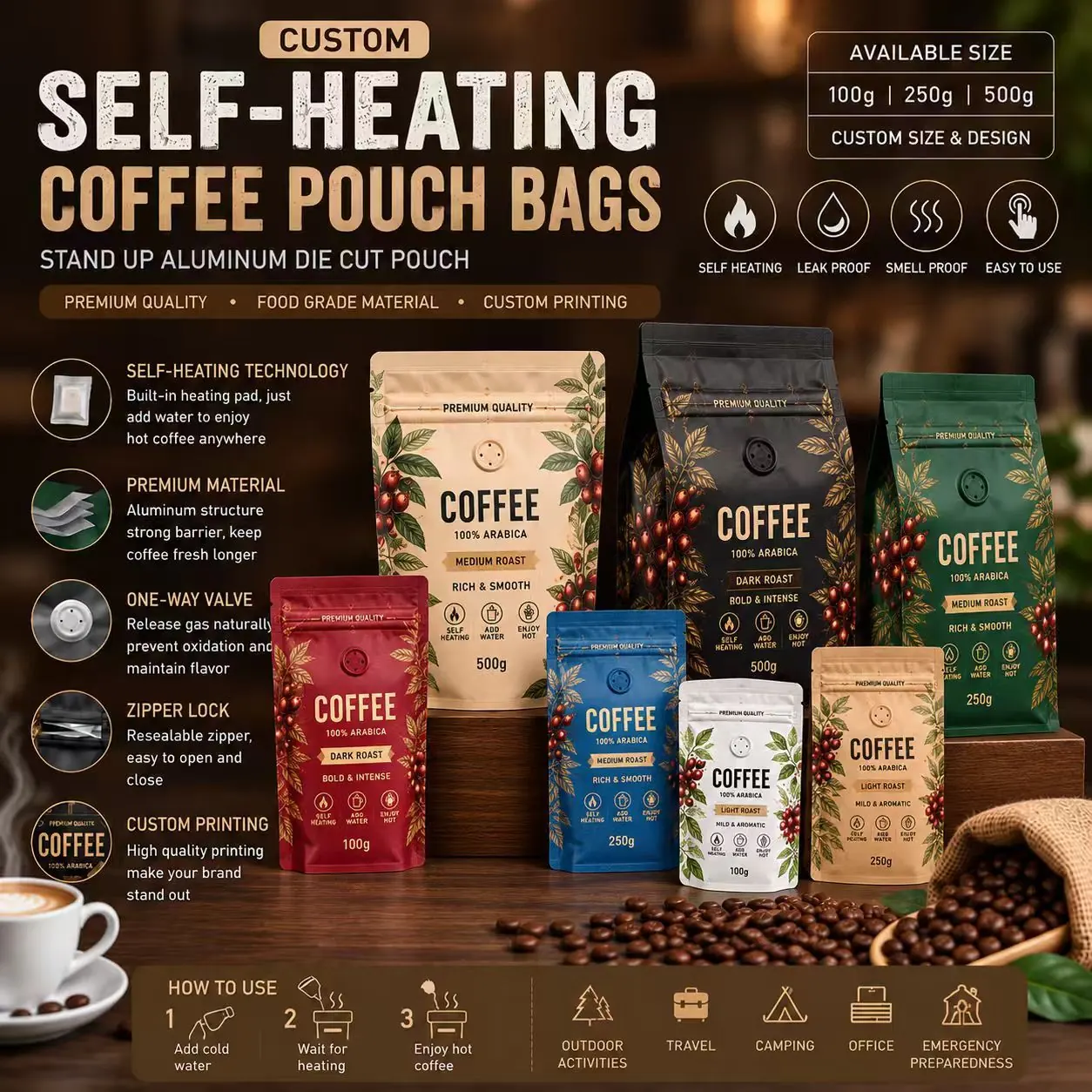
- One-way degassing valve options
- Metallized and tinted barriers for light and oxygen protection
- Resealable zipper options
- Side-gusset, flat-bottom, and stand-up formats

Key Takeaways
Coffee Bag Decisions at a Glance
- Format first: side gussets for density, flat-bottom for shelf presence, stand-up for versatility.
- A one-way valve is standard for fresh roast; a zipper or tin tie keeps the pack usable after opening.
- Metallized (VMPET) film for typical retail timelines; foil (AL) when coffee sits longer or ships far.
- MOQ 100–500 pcs per design, with several blends or sizes sharing one order.
Customization
Built to Your Specification
Material structures, formats, and finishes are tailored to your product, barrier requirements, and brand — produced in our own factory in Huizhou, China, on 10 production lines staffed by 100+ workers.
Material Structure
Multi-layer lamination matched to your barrier needs.
Formats
Stand-up, flat, quad-seal, spouted, and shaped pouches.
Printing
Rotogravure and flexographic, up to 10 colors.
Closures
Zippers, valves, windows, and tear notches.
Inside the Factory
Customized Coffee Bags — From Print to Pallet
A one-minute walk through our floor: customized printed coffee bags fresh off the press, the showroom lineup, fully automatic bag-making, and a one-way valve being fitted to a finished pouch.

Choosing
Side Gusset, Flat-Bottom or Stand-Up?
The three formats all hold coffee well; they differ in what they emphasise. Side-gusset bags pack densely and carry the lowest cost per kilogram — the classic roaster choice. Flat-bottom pouches add two more printable panels and a square base that presents best on premium shelves. Stand-up pouches are the flexible middle ground, common for subscription refills and smaller roasters.
There is no single right answer, and switching later is expensive in more ways than one — customers recognise the pack. We will talk through your shelf, your price point and your volumes before quoting, because the format decision drives everything else.
Valves
Which Valve Goes on a Coffee Bag?
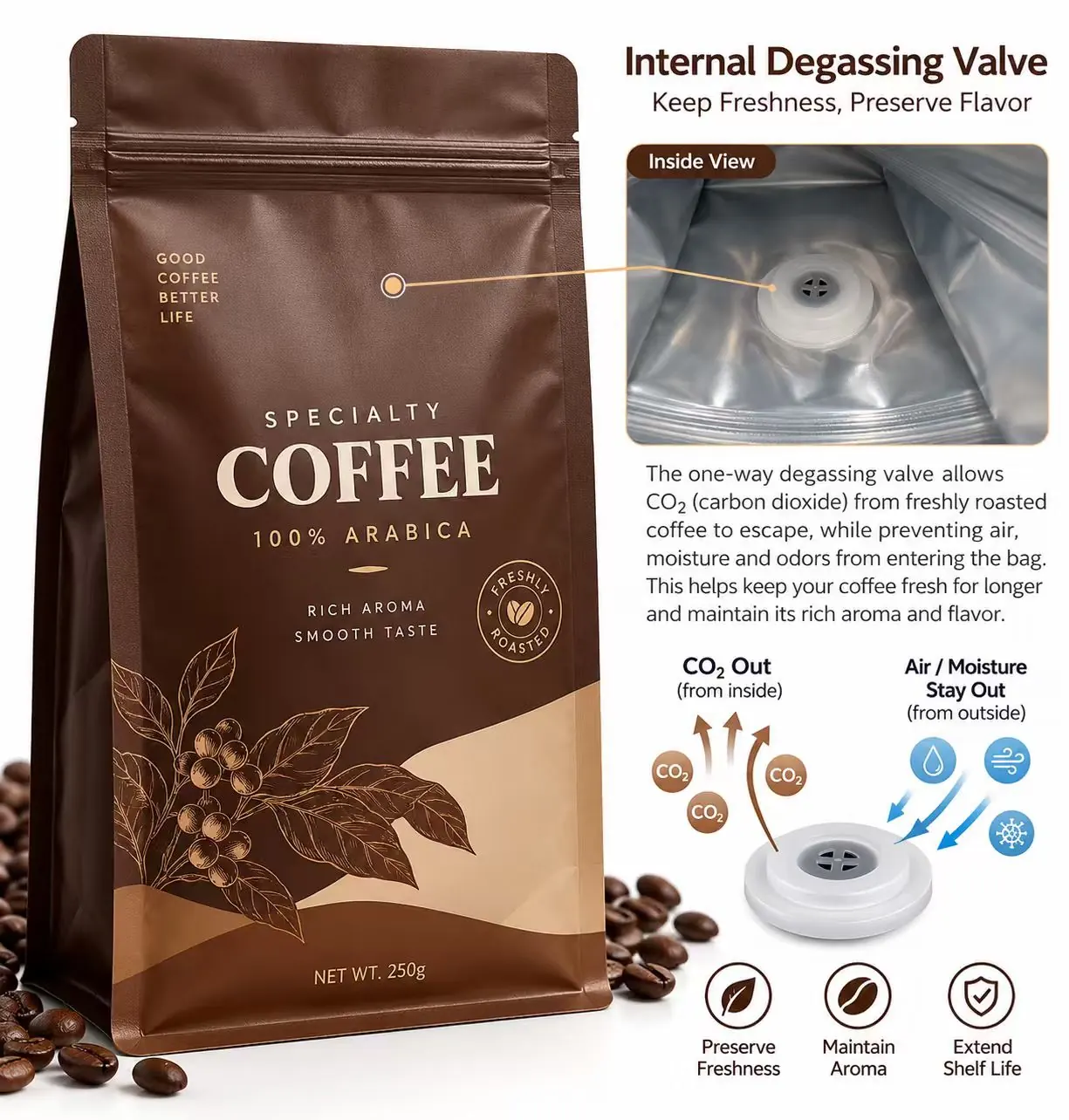
Every retail coffee bag needs a one-way degassing valve — the small disc that lets CO₂ escape after roasting while keeping oxygen out. Roasted coffee gives off roughly 5–10 litres of CO₂ per kilogram over its first days, enough to pillow or split a sealed bag with no valve. Fill after a 2–4 day degassing rest, or seal straight off the line with a valve that vents immediately.
We fit 5 mm and 8 mm one-way valves, one or two per bag, on the front panel or the gusset, and can match the valve colour to the film. More detail: how the degassing valve works and valve placement and customized valve stickers.
Sizes
Common Coffee Pack Sizes
| Pack size | Typical format | Notes |
|---|---|---|
| 250 g | Side gusset / flat-bottom | The core retail size for whole bean and ground |
| 500 g | Flat-bottom / stand-up | The middle size for regular brewers |
| 1 kg | Flat-bottom / side gusset | Cafés, offices and subscription refills |
| 5–20 g | Three-side-seal sachet | Samples, hotel portions and stick packs |
FAQ
Coffee Bags — More Questions Answered
Do I need a degassing valve on my coffee bags?
If you pack within about 7 days of roasting, yes — fresh-roasted coffee keeps releasing CO₂ (roughly a litre per kilogram in the first days, most of it in the first 48 hours), and a sealed bag will puff, distort or fail at a seam. If you rest the beans in open bins for a week first, the pressure problem largely disappears and a bag without a valve can work. See the three cases, with the reasoning.
How long should coffee rest before it is packed?
Fresh-roasted coffee degasses for roughly 7 to 10 days, with most of the gas released in the first 48 hours. Pack straight off the cooling tray and you need a valve; rest the beans in open bins for about a week and you usually do not. Either way leave headspace, keep the beans off the membrane, and do not fill above the valve.
What is the minimum order for customized printed coffee bags with a valve?
100–500 pcs per design for standard pouches, which is how small roasters run several blends in one print run. At those quantities the print is digital; it moves to gravure as the run grows — see the digital vs gravure comparison for how the cost splits, or send the artwork and we quote both.
Can I buy just the valves, without the bags?
No — valves are fitted to the pouches we make, not sold as loose parts. The applicator heat-seal that seats a valve has to suit both the film and the valve body: too much heat or dwell warps the base out of flat, and a patch fitted somewhere else is a combination nobody has tested. If you already have bags and want valves added, we would rather quote the bag and the valve together.
Do dark roasts still need a valve?
Usually yes. Dark roasts degas less than light roasts but still release CO₂ for days. A valve costs little and removes the timing pressure — most roasters keep it regardless of roast level.
Kraft-look coffee bags with a valve?
Yes. A kraft-look laminate carries the natural aesthetic while keeping a true barrier layer underneath, and a valve can be fitted as normal.
VMPET or foil — which should I choose?
VMPET (metallized) covers typical retail timelines at a friendly cost. Foil adds barrier for long storage, export shipping and premium whole-bean lines. We match it to your roast-to-shelf timeline.
Can several blends share one print run?
Where the design allows, yes. It is one of the practical ways we keep MOQ at 100–500 pcs per design for small roasters.
How fast can I get printed samples?
5–7 days for customized printed samples at US$120 for 1–2 pieces. Stock samples are free apart from freight.
Is a valve sticker the same as a built-in degassing valve?
Yes — “valve sticker”, “valve patch” and “stick-on valve” all describe the same component: a patch carrying a silicone membrane, heat-sealed over a hole punched in the pouch. It is not a different product from a built-in valve; what differs is who applies it. We fit the valve in our own plant as part of the bag order and do not supply the patches loose.
Sourcing
What a Coffee Bag Quote Should Include
Coffee bag pricing is mostly structure and volume: the barrier layer, the closures and the quantity. A valve, a zipper and a foil layer each add cost — and each one either earns its place or does not, depending on your shelf timeline and price point. We would rather quote three options and let you choose than bury assumptions in a single number.
What should be included regardless of price: food-contact documentation, a dieline matched to the format, a print proof before production, and sample packs you can fill and seal on your own equipment. If a quotation omits those, it is not finished.
Repeat orders reuse the printing cylinders, so the second run is cheaper than the first. The print film fee is waived on colour-matching orders, which makes seasonal blends and limited editions practical for small roasters.
Content last reviewed: September 2026