
Blog
Customized Coffee Bags with Valve: A Buyer's Guide
A customized coffee bag combines three decisions that interact: the barrier structure, the valve, and the closure — and changing one usually forces a change in the others. The valve has to sit on a flat panel away from the seal, which is why the pouch format is often decided by where the valve can go rather than by shelf appearance. This guide covers structure, valve and closure as one specification, with the fill weights and formats each combination suits.
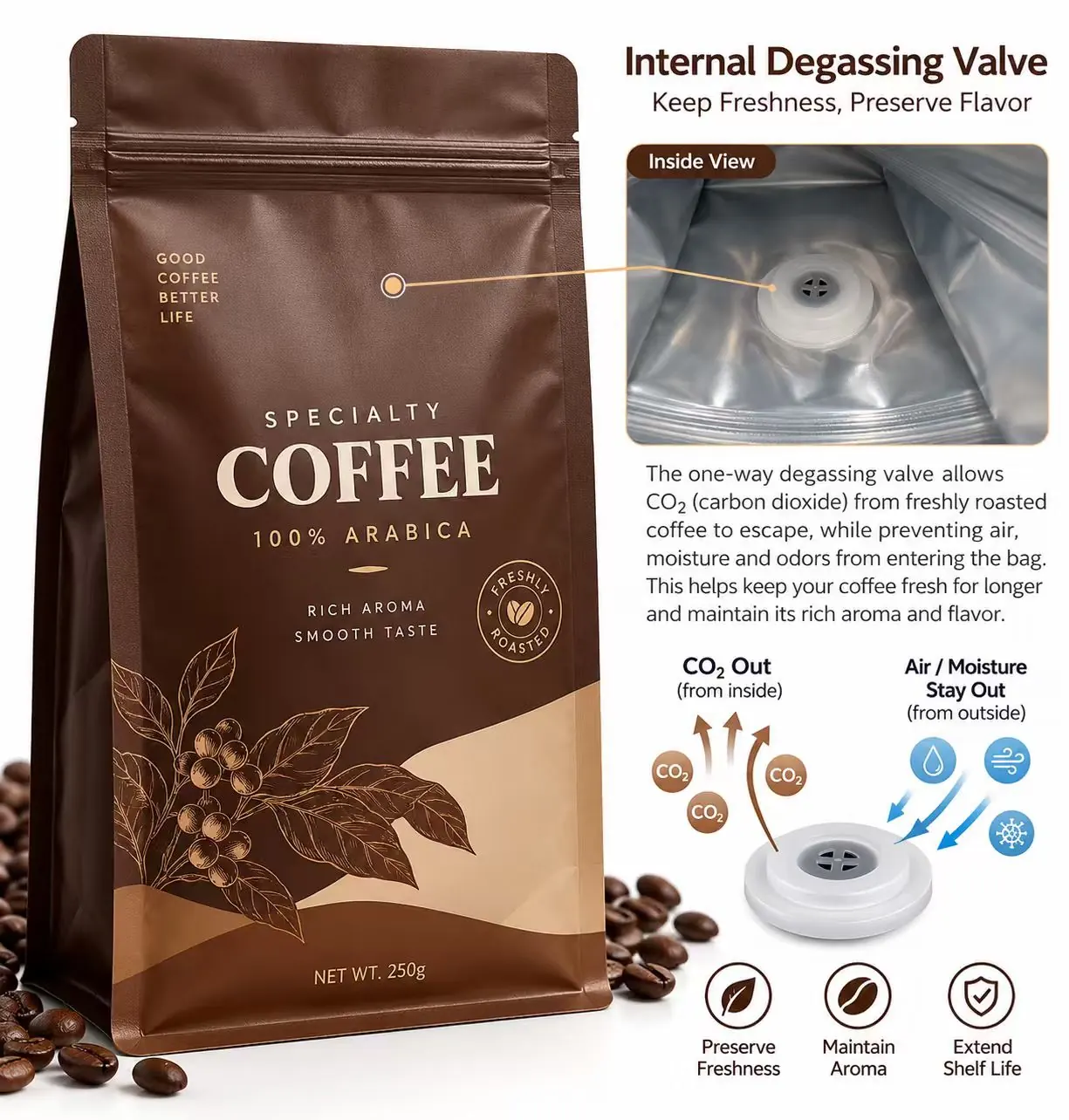
Most content about valved coffee packaging answers the question a roaster asks before buying: do I need a valve at all? This guide is for the point after that — you have decided the bag needs a one-way degassing valve, and now the questions are practical. Which formats take a valve. Where the valve sits. What "customized" actually changes. What a factory needs from you before quoting. And what a sensible first order looks like without locking six months of cash into one print run.
Everything below is written from the manufacturing side. We make customized printed coffee pouches — side gusset, stand-up and flat-bottom formats, with or without a valve — and the notes here are the questions buyers ask us most, answered the way we answer them on a quote.
Which coffee bag formats take a valve
Any format with a laminated barrier wall can carry a degassing valve patch, but three formats cover almost every valved coffee order:
- Side gusset bags — the classic roastery format. Tall, boxy, bricks well in a case, and the traditional home of the valve patch on the back panel. Most 250 g to 1 kg whole-bean retail bags are side gusset.
- Stand-up pouches — the format shoppers see most on specialty shelves. Bottom gusset keeps the bag upright, a zipper adds resealability, and the valve usually sits on the front panel above the label zone.
- Flat-bottom pouches — five printable panels and a premium shelf presence. Common for 340 g (12 oz) and 1 kg premium lines where the brand wants the bag to stand like a box.
Roll film for form-fill-seal lines can also be made with valves applied in-line, but that is a filling-line conversation: the valve applicator has to match your machine. If you fill in-house, tell us the machine model when you enquire — film and filling line have to be qualified together, and the valve applicator is part of that qualification.
The valve and valve sticker: what "customized" means here
A degassing valve is a small multi-layer plastic patch — typically around 25–30 mm across — with a silicone membrane that lets CO2 out under pressure and reseals against outside air. It is heat-applied to the inside of the film before the bag is formed. Two specification points matter more than the rest:
Flow rate: standard versus high-flow
Standard valves suit normal retail packs: 250 g to 1 kg of whole bean, filled at ambient temperature. High-flow valves move more gas faster and are used when the fill weight is large (multi-kilo bags), the coffee is filled hot, or the roast is exceptionally fresh at packing. A valve that is undersized for the gas load is the usual cause of a bag that slowly puffs up on the shelf — so the valve spec follows the fill, not the other way round.
Placement: front, back, high or low
Placement is a print and packing decision, not an afterthought. Front-panel placement turns the valve into a visible freshness cue; back-panel placement keeps the face of the bag clean for artwork. Vertically, the valve sits above the coffee bed so the gas layer — not the beans — sits against it. On zipper pouches it must also clear the zipper track and the tear notch. We confirm exact valve position on the dieline before anything is printed, because a valve that lands inside the label panel is a reprint.
Valve stickers: stock, clear or customized printed
Because a degassing valve is applied as a sticker-shaped patch, "one way valve sticker" is how many buyers search for exactly this part. Three options cover most orders: a stock black one-way valve sticker (fastest, no tooling), a clear version that disappears against the printed artwork, and a customized printed valve sticker that carries your logo or a freshness message and turns the valve into brand space. Printed stickers add a small plate charge and a few days to setup; degassing performance is identical across all three, so the choice is purely visual and budget. Tell us which you want at artwork stage and it goes on the dieline like any other panel element.
If you are still weighing whether the valve is needed at all — degassing timelines, when a rested coffee can ship valve-free — that decision logic lives in One-way valve coffee bags: do you actually need one?
Barrier: what protects the coffee behind the valve
The valve manages CO2. The barrier manages oxygen, moisture and light — and for shelf life, the barrier does more of the work. Typical structures on customized coffee bags:
- Metallized PET (VMPET) laminates — the workhorse: strong oxygen and light barrier at a moderate cost, used on most mid-market coffee.
- Aluminium foil laminates — near-total light and gas barrier for premium beans and longer shelf-life targets.
- High-barrier clear structures — when the brand wants a visible window on the bean, at the cost of light protection. Usually paired with shorter best-before dates.
For most retail coffee the practical test is simple: after nitrogen flushing and sealing, the headspace oxygen reading on your line decides whether the barrier is adequate. We build the structure to your shelf-life target and your filler's flush capability, then prove it on samples.
Customized printing: what changes the price
Customized coffee bags are priced on five lines, and the valve is the smallest of them:
- Print method and colour count. Rotogravure printing (up to 10 spot colours, Pantone-matched) rewards volume: the cylinders are amortised across the run. Digital printing suits short runs and seasonal labels with no cylinder cost. Matte, glossy, soft-touch and spot-UV finishes are surface choices on either route.
- Structure and barrier. Foil costs more than metallized; high-barrier clear costs more than either.
- Features. Zipper, tin-tie, tear notch, hang hole, degassing valve — each adds a small per-unit figure and, in the valve's case, an application step.
- Size. Bigger film area, bigger price; but size is usually set by the coffee, not the budget.
- Quantity. The dominant line. Unit price falls steeply from sample quantities to a few thousand, then flattens.
For sizing the bag itself — why a "12 oz bag" is not a measurement — see why the weight on the front is not the size you order, and the coffee-specific version of that argument in our coffee sizing guide.
MOQ and the first order, without over-committing
A first valved-bag order does not have to be a 50,000-piece gravure run. The usual path:
- Samples first. Stock samples are free (courier at cost). Customized prototypes — your size, structure, valve and print concept — are a small tooling and setup figure for 1–2 pieces, typically 5–7 days.
- Short runs digitally printed. Digitally printed pouches run from around 100–500 pieces, which is enough for a market test, a subscription launch or a single-origin release without cylinder cost.
- Gravure once the design is proven. Full customized gravure runs start in the low thousands of pieces, where per-unit pricing drops sharply and the cylinder investment pays back.
The mistake we see most from new roasters is ordering the big run before the bag has survived a real filling day. Fill rate, flush behaviour, seal window and valve performance on your line are all sample-stage facts. A signed-off sample that names the structure, valve model, valve position and seal settings is what bulk production is built against.
What to send for a quote
Send these and the quote comes back specific instead of a range:
- Coffee form (whole bean / ground), fill weight, and roast-to-pack timing
- Bag format and target size, or the competitor bag you are matching
- Barrier expectation or shelf-life target
- Valve: standard or high-flow, preferred panel, visible or hidden
- Features: zipper, tin-tie, tear notch, window
- Print: colours, finish, artwork status (print-ready or needs dieline)
- Quantity per design and whether sizes will repeat
Our full format range lives on the coffee bags product page, and the wider retail context — where valved coffee bags sit among snack and food formats — is in food packaging pouches: types and materials.
If the structure you need is metallised or foil rather than clear — a matte black coffee bag with a valve, for example — our sister site covers smell-proof mylar coffee bags with the same valve and degassing options, from the same factory.
Sources and standards
Primary references for degassing behaviour and packaging practice referred to in this guide:
- Specialty Coffee Association (SCA) — coffee freshness and packaging resources
- National Coffee Association (NCA) — coffee packaging and storage guidance
- BRCGS Global Standard for Packaging Materials (BRCGS)
Frequently asked questions
How much does a customized coffee bag with a valve cost?
Unit price is driven mainly by quantity, print method and barrier, and the valve adds a small per-unit figure. Digitally printed short runs from around 100-500 pieces suit market tests; gravure runs in the low thousands drop the unit price sharply. Send size, structure, print and quantity for a written quote — indicative figures on any website are not a quotation.
Where should the degassing valve be placed on the bag?
Above the coffee bed so the gas layer sits against the valve, clear of the zipper track and tear notch on zipper pouches. Front placement shows the valve as a freshness cue; back placement keeps the artwork clean. Exact position is confirmed on the dieline before printing.
What is the difference between a standard and a high-flow valve?
Flow rate. Standard valves handle normal retail fills of 250 g to 1 kg packed at ambient temperature. High-flow valves move more gas and suit multi-kilo bags, hot filling or exceptionally fresh roasts. An undersized valve on a heavy gas load is the usual cause of shelf puffing.
Can I order customized coffee bags with a valve in small quantities?
Yes. Digitally printed pouches run from around 100-500 pieces per design with no cylinder cost, which is how most roasters test a design. Customized prototypes of 1-2 pieces are available for fit and seal testing before any print run.
Do you print the valve on the artwork or apply it separately?
The valve is a physical patch heat-applied to the inside of the film before bag forming — it is not printed. Its position appears as a marked circle on the dieline so the artwork is designed around it.
How long does a customized valved coffee bag order take?
Sampling for customized prototypes is typically 5-7 days. Bulk lead time depends on print method, structure and quantity and is confirmed in the written quotation; stock-format digital runs are faster than gravure runs, which include cylinder production.
Have a pack like this to quote?
Send the product, how it will be filled and stored, the format or an area to advise on, and your quantity. You get back a named structure, a colour count, a minimum tier and a line-by-line price — usually within one working day.