
Blog
Food Packaging Pouches: Which Structure, Material and MOQ
Choosing a food packaging pouch comes down to four questions: what the product is, what shelf life it needs, how it will be filled, and how it will be displayed. Shelf life is the constraint that decides the film structure, and it is the one buyers most often leave until after the format is chosen. This guide takes the four questions in order, with the formats and structures each combination points to.
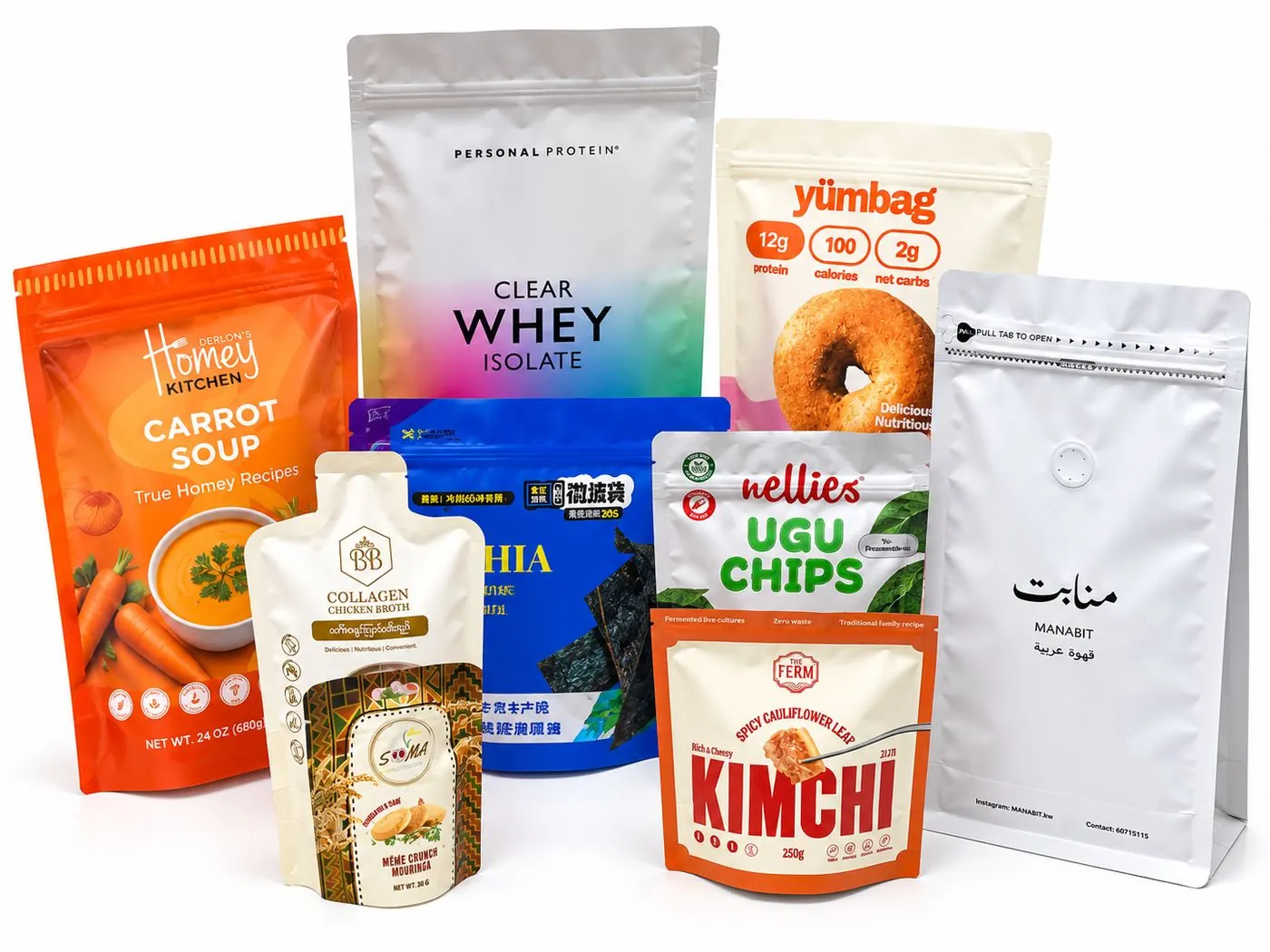
Search for food packaging pouches and you get one term back for what is really a family of decisions: which structure, which barrier layers, which closures, and which rules apply to the food inside. Buyers who treat the term as one product tend to order the pouch that photographs well and discover the problems later — a crisp that stales in three weeks, a pouch that will not run on their filler, a film with no food-contact paperwork behind it.
This guide is the map we wish every first-time food buyer read before quoting. It covers the five structures, how materials match product types, the compliance documents that actually matter, and the realistic minimum order and sampling path — all from the manufacturing floor side, where these decisions get made every day.
The five structures, and what each is for
Every food pouch on the shelf is one of five basic structures. The differences look cosmetic; they are not. Format changes filling behaviour, shipping density, shelf presence and cost per unit.
- Stand-up pouches. The retail workhorse. A bottom gusset lets the pack stand on shelf, the cost sits in the middle of the range, and it runs on most vertical fill-seal lines and pre-made pouch machines. From 50 g sample packs to 2 kg bulk, this is the default for snacks, dry food, powders and treats. See the stand-up pouch range.
- Flat-bottom pouches (box-bottom). Five printable panels and a square base that stands perfectly and faces forward on shelf. More film, more converting cost — you choose it when the shelf moment is worth paying for: premium coffee, gift food, high-end supplements. See flat-bottom pouches.
- Three-side-seal pouches (flat sachets). No gusset, no stand. The lowest cost per unit and the thinnest shipping profile — single-serve portions, sauce sachets, sample packs. See three-side-seal pouches.
- Side-gusset bags. The classic coffee and tea format, block-bottomed and brick-shaped until opened. Efficient on film and pallet space, and the traditional choice for 250 g–1 kg dry goods. See side-gusset bags.
- Spouted pouches. A flexible pack with a rigid cap: liquids and pastes — baby food, sauces, honey, gels. The spout and cap are separate operations, which is why the MOQ and unit price sit above the other four. See spouted pouches.
Two special categories sit slightly outside this list because their structures are driven by process, not shelf display: retort pouches for sterilized shelf-stable food and microwave-ready bags that go from freezer to microwave. Both have their own material and testing requirements.
Materials: the barrier decides, not the look
The printed layer is what the shopper sees; the layers behind it decide whether the food inside survives its shelf life. A food pouch is a laminated structure, and the structure is chosen against three questions: how much oxygen the product tolerates, how much moisture it gains or loses, and how much light it can take.
- Dry snacks and confectionery. A standard structure like PET/AL/PE or PET/metallized PET/PE blocks light and oxygen completely — the priority is keeping the crunch, which is why most snack pouches are also nitrogen-flushed.
- Powders (protein, flour, drink mixes). Moisture is the enemy, and so is clumping from humidity swings in transit. A foil or high-barrier layer with a strong seal web is standard.
- Frozen food. The film has to stay flexible and seal reliably at filling temperature, then survive freezer storage and handling. Low-temperature sealants and puncture-resistant layers matter more than gloss.
- Wet and retort food. Retort pouches take a sterilization cycle at high temperature, which only specific laminated structures with aluminum foil can survive — this is the most demanding food structure we build.
- Sustainability requests. Where shelf life allows, recyclable mono-material (all-PE) structures replace mixed laminates. They are not a drop-in swap for every product — the barrier is lower, so the product has to be tested; ask us for the recyclable options available for your structure.
If the food is sold by weight and you are not yet sure what size the pouch needs to be, read our food pouch sizing guide first — sizing mistakes are the most expensive error in this category because a wrong size means new film, new cylinders and a new print run.
Food contact: the paperwork that has to exist
Food-contact film is regulated, and the certificate has to match the actual structure you import — not a similar one from a brochure.
- United States: every food-contact layer should comply with FDA 21 CFR requirements for its polymer class (for example 21 CFR 177.1520 for polyolefins), and the supplier should be able to issue a food-contact statement naming the structure.
- European Union: Commission Regulation (EU) No 10/2011 on plastic materials intended to come into contact with food, with overall and specific migration limits.
- Factory-level systems: BRCGS certification for packaging materials is what most retailers and large brands audit against. Ours runs at BRCGS Issue 7 (Grade B) alongside ISO 9001, and every food structure ships with FDA and EU 10/2011 reports.
A practical rule for vetting any supplier: ask for the food-contact report before the sample, and check that the report names the same layers as the quote. If the paperwork and the structure do not match, nothing else in the conversation matters. Our customized service page lists the documents that ship with every order.
What can actually be customized
Almost everything on the pouch is a decision, and each one is cheap at the design stage and expensive after printing:
- Printing. Rotogravure (up to 10 colours, photographic quality, cylinder-based) or flexographic. Gravure cylinders are a one-time cost per design; digital printing on stock pouches avoids cylinders entirely for small runs.
- Closures. Press-to-close zippers, slide zippers, tin-ties, spouts with screw or flip-top caps, laser scoring for easy tear.
- Features. Degassing valves (coffee and fermented products), clear windows, hang holes, matte or gloss finish, soft-touch coating.
- Shape. Customized die-cut silhouettes for seasonal and promotional packs.
Our food packaging range shows the combinations food brands order most, and laminated roll film covers automatic filling lines that make their own bags.
MOQ, samples and the realistic first order
The honest numbers, because these are the two questions every food brand asks first:
- Standard pouches (stand-up, flat-bottom, three-side-seal, side-gusset): MOQ 100–500 pieces per design for digitally printed stock sizes — enough to test a design or a market without a container-sized commitment.
- Retort, spouted and microwave-venting structures: MOQ 5,000 pieces, because the converting and testing steps are heavier.
- Printed samples: 5–7 days, US$120 for one to two pieces, credited against the production order.
- Stock samples: free apart from freight, so you can run a fill test on the real structure before paying for artwork.
That sequence — stock pouch fill test, then printed sample, then production — is deliberately cheap at every step where a mistake is still fixable. It is the same path we put first-time food buyers on, and it is the shortest route to a pouch that works on the shelf and on the line.
How we help you choose
Send us the product, its fill weight, target shelf life, how it will be filled and where it will be sold. We will come back with two or three structure-and-format options, the food-contact documents for each, and a costed sample path. If you already have a pouch you are replacing, sending it to us speeds everything up — we can measure the structure and quote against it directly.
This article is a category overview. Barrier selection, shelf-life claims and compliance requirements depend on the specific product, process and destination market, and should be confirmed with food-contact documentation and a fill test before production.
Sources and standards
Primary sources for the food-contact rules referred to in this guide:
- 21 CFR 177.1520 — Olefin polymers for food contact (US eCFR)
- EU Regulation 10/2011 — Plastic materials in contact with food (EUR-Lex)
Frequently asked questions
What is the best pouch format for food packaging?
There is no single best format. Stand-up pouches are the default for snacks, dry food and powders because they balance shelf presence, filling compatibility and cost. Flat-bottom pouches win for premium positioning, three-side-seal sachets win on unit cost for single-serves, and spouted pouches are the choice for liquids. The product, filling line and shelf strategy decide — not the format’s looks.
What material are food packaging pouches made of?
Almost always a laminated multi-layer film: an outer print layer (usually PET), a barrier layer (aluminum foil, metallized PET, or EVOH-type barriers), and an inner food-contact sealant layer (PE or CPP). The combination is chosen against oxygen, moisture and light sensitivity of the specific food, and every layer must carry food-contact compliance.
What is the minimum order for customized printed food pouches?
For standard structures in digitally printed stock sizes, 100–500 pieces per design. Custom-width gravure runs start higher because cylinders are a one-time per-design cost. Retort, spouted and microwave-venting structures run at 5,000 pieces minimum due to heavier converting and testing.
Do food pouches need FDA or EU certification?
The film needs to comply with the food-contact rules of the destination market: FDA 21 CFR requirements in the US, Regulation (EU) No 10/2011 in the EU. Suppliers should issue a food-contact declaration naming your exact structure, and retailers increasingly also expect the factory to hold BRCGS or equivalent certification. Ask for the documents before samples, and check the structure named on the report matches your quote.
How long does a customized food pouch order take?
Printed samples run in 5–7 days. Production after sample approval is typically 10–15 days for standard structures plus shipping. First orders take longer at the front end because artwork, cylinders and food-contact paperwork are all being set up for the first time.
Have a pack like this to quote?
Send the product, how it will be filled and stored, the format or an area to advise on, and your quantity. You get back a named structure, a colour count, a minimum tier and a line-by-line price — usually within one working day.