
Blog
Sizing a Food Pouch: Why the Weight on the Front Is Not the Size You Order
A pouch's nominal size does not tell you its fill weight: the same 250 g label covers very different interior volumes depending on format, gusset and film thickness. Fill weight is a function of product bulk density and usable interior area, which is why copying a competitor's pouch size is the most expensive sizing mistake in packaging. This guide gives the dimensions behind common nominal sizes and the arithmetic for working backwards from a fill weight.
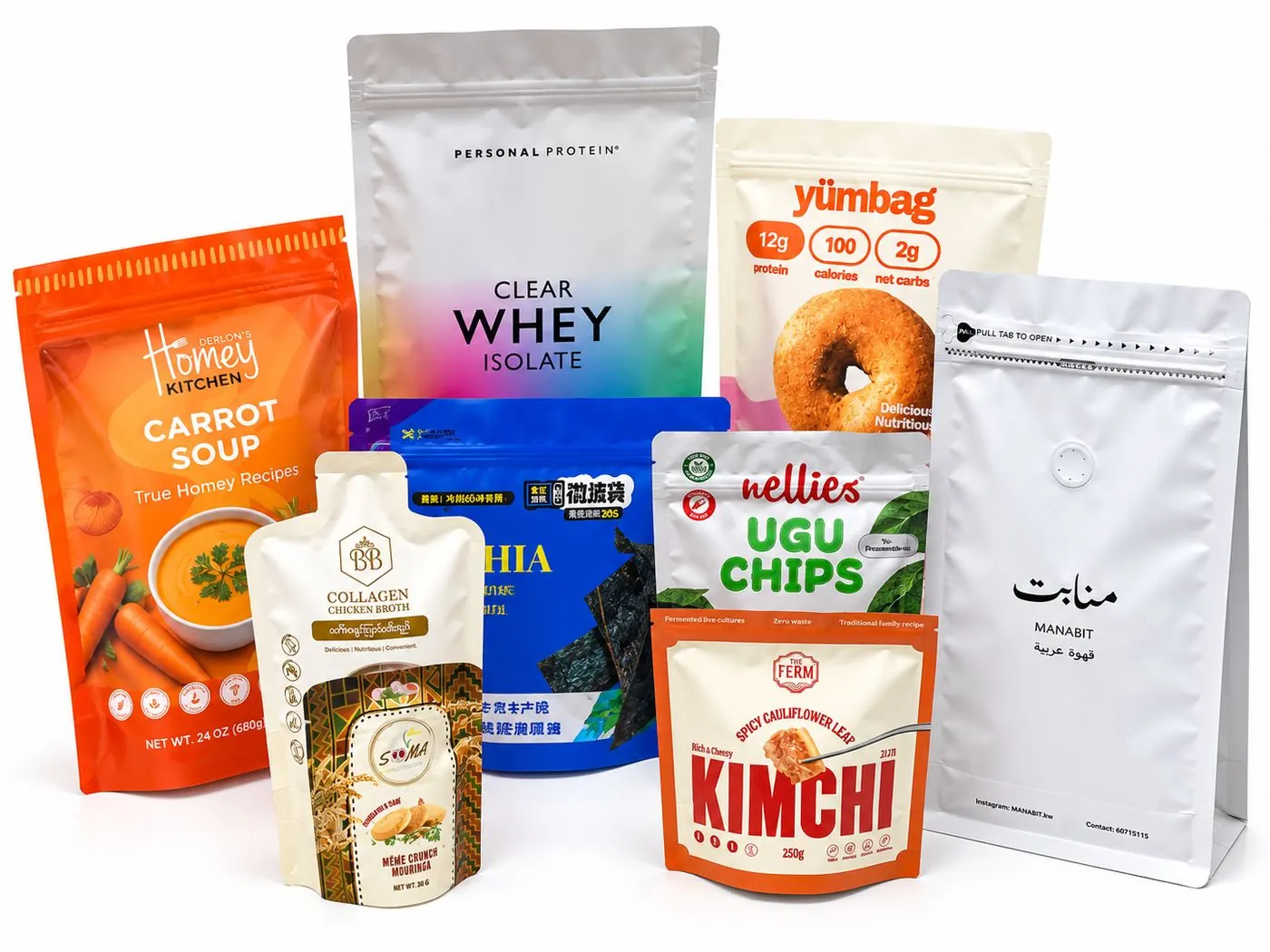
A buyer picks up a competitor's pack, reads 250 g on the front, and orders twelve thousand pouches in roughly that size. Six weeks later the pouches are on the pallet, the filler is running, and the product either will not fit or rattles around in a pouch that looks half empty on the shelf. The number on the front of a food pack is a weight. The pouch itself is a volume. Between the two sits everything that changes when you change the product — and in food, almost everything changes.
This is one of the few mistakes in packaging that is genuinely cheap to avoid and genuinely expensive to make, because a wrong size is not something you correct on press. It is new film, new cylinders and a new print run, against a shelf date you have already promised to a retailer.
Weight is sold. Volume is packed
Food is not a fixed-density product. The same 250 g can occupy visibly different space depending on six things:
- Product form. Whole nuts, nut flour and nut butter are the same ingredient and three different pouches. Anything with trapped air between pieces — crisps, puffed snacks, extruded cereal — occupies several times the volume of the same weight milled fine.
- Moisture content. Dried fruit, dried vegetables and dried seafood all sit somewhere on a moisture curve, and the same weight of the same fruit at two different moisture levels fills differently. If you buy in bulk, expect lot-to-lot movement.
- Particle size and fines. A seasoning blend, a cocoa powder and a flour can share a bulk density on paper and still flow differently. Fines pack tighter, bridge in hoppers, and behave differently again in the seal area.
- Settling in transit. Granules, rice and kibble settle under vibration. A pouch that looked correctly filled on the line can look slack after a truck ride, which reads as short weight to a consumer even when the weight is exact.
- Gas flushing. Snack pouches are usually flushed with nitrogen to protect fragile product, and the pack is expected to hold a pillow shape on the shelf. That expectation is part of the specification, not a side effect — the fill volume and the headspace have to be set with the flush running, not without it.
- Fill temperature. Frozen and chilled products are packed cold, and films behave differently cold: stiffness, seal window and how the base spreads all move. A format that stands perfectly at ambient may not stand at −18 °C off the line.
The practical consequence: a pouch sized for one product in your range can be wrong for the next one at the same declared weight. If your range spans a powder and a snack, your range probably needs to span sizes too.
The five measurements that define a food pouch
When you specify a food pouch, five things have to be written down. Miss any of them and the supplier is guessing, which is the same as you guessing.
| Measurement | What it controls | Why it matters more in food |
|---|---|---|
| Width | Front panel, machine jaw, fill head fit | Sets your printable area — and food labels carry more mandatory copy than most categories |
| Height | Volume, fill weight, shelf presence | Where the weight/volume mismatch shows up first |
| Bottom or side gusset | Standing stability, base volume, fill opening | A deeper gusset buys capacity without making the pouch taller on a shelf, and a wider base matters once the fill weight is a kilo |
| Zipper, tear notch and opening | Resealability, opening force, seal area | Reseal matters more in food because the pack is opened many times; the zipper must sit clear of the fill line |
| Headspace | Seal integrity, settling room, filler tolerance | Powder and fines in the seal are the most common cause of a weak seal in food packing |
Notice how these interact. Choosing a shorter, wider pouch to fit a shelf changes the machine jaw and the print layout. Choosing a deeper gusset to gain volume changes how the pouch stands once it is two-thirds empty. This is why copying the dimensions of a pack you like, without copying the fill weight and the product form, so often fails.
Headspace is not wasted space
Buyers often try to solve capacity by filling to the zipper. That is the wrong direction. A food pouch needs three separate allowances above the product:
- Seal area. The top seal needs a clean band of film with no product in it. In powder, flour, seasoning and ground products, dust in the seal is the single most common reason a pack leaks slowly on a shelf. A wider seal band and a clean fill nozzle are cheap; a recall is not.
- Settling room. Granules, kibble, rice and dried fruit will compact. The pouch should look correctly filled after the product has settled, not only at the moment it leaves the filler.
- Filling tolerance. Your filler is not perfectly accurate, and neither is any other. A pouch that fills exactly right at the nominal weight has no margin for the top of the tolerance band.
If the pack is gas-flushed, headspace also sets the shape the consumer sees. A snack pouch that is filled to the seal has nowhere for the flush to go and will look crushed rather than plump.
The cheap test that prevents the expensive mistake
Before you commit a print run, spend a fraction of it on a fill test. This is the step that separates a confident order from a hopeful one.
- Buy stock pouches in two or three candidate sizes. Unprinted stock pouches exist precisely for this, and they are the cheapest packaging decision you will make all year.
- Fill with your own product, at your own fill weight, on your own equipment if you can. A pouch filled by hand in an office and a pouch filled by a weigher on a line are different experiments.
- Seal them properly — same heat, same pressure, same flush you would use in production — and record the headspace you had above the product.
- Settle them the way transit will. Shake, drop and stack the filled pouches for a few minutes, then re-measure. This is the step most buyers skip, and it is the one that predicts how the pack looks in a carton.
- Leave them for 48 hours, then re-measure and re-weigh. Watch for the base spreading, the pouch refusing to stand, the zipper disappearing under the product, and any softening of the seal. Store one at room temperature and one somewhere warm if your market gets hot.
Then, and only then, place the printed order. Two sizes of stock pouch and an afternoon is a rounding error next to a reprint.
What sizing does to cost
Size sets cost through three channels: film area, print area, and format complexity. A deeper gusset uses more film. A larger panel gives your design more room but also more ink coverage. A zipper, a valve or a spout adds an operation and a component.
Which is why the right question is not what is the biggest pouch I can afford but what is the smallest pouch that fills correctly, seals reliably and stands well. That pouch also ships better, because flexible packaging is billed on space far more often than on weight.
How we help you get this right
Send us the fill weight, the product form, whether the pack is gas-flushed, your target shelf life and where it will be sold. If you are undecided on size, say so — we will propose two or three formats with the dimensions written out, and you can fill-test them before committing artwork. Printed samples run in 5–7 days at US$120 for one to two pieces, credited against the production order, and digitally printed stock sizes start from 100–500 pieces per design, so a small first run of a real design is possible without waiting for a container-sized order.
If you are still choosing between formats, the format comparison covers stand-up, flat-bottom, side-gusset and three-side-seal on shelf presence, filling and cost. Food-contact requirements for the film itself are covered in our compliance guide, and the food packaging range shows the structures we build most often.
This article explains how food pouch size is determined. Bulk density, fill weight and headspace requirements differ by product form, moisture, filling equipment and market, so dimensions should be confirmed on a fill test with your own product rather than taken from a table.
Sources and standards
Primary sources for the rules and test methods referred to in this guide:
- 21 CFR 177.1520 — Olefin polymers for food contact (US eCFR)
- EU Regulation 10/2011 — Plastic materials in contact with food (EUR-Lex)
Frequently asked questions
Can I use one pouch size across a whole product range?
Rarely at the same fill weight. A 250 g powder, a 250 g snack and a 250 g dried fruit occupy visibly different volumes, and gas-flushed packs need headspace the others do not. Either order two or three sizes, or size for the least dense product in the range and accept the extra headspace on the rest.
How much headspace should I leave in a food pouch?
Enough for three things at once: a clean band for the top seal with no product dust in it, room for granules or kibble to settle in transit, and margin for your filler's weight tolerance. If the zipper is crowded, or product is sitting in the seal, the pouch is over-filled even if it closes.
My pouches look half empty after shipping, but the weight is correct. Why?
Settling. Granules, rice, kibble and dried fruit compact under vibration, so a pouch that looked correctly filled on the line can look slack in the carton. Run a settle test before printing: shake and stack filled stock pouches for a few minutes, then re-measure the fill level and the headspace.
Do I need a physical fill test, or can I calculate the size?
Calculate first, test second. A calculation gets you to two or three candidate sizes; only filling your own product, sealing it and waiting 48 hours tells you which one is right. Stock unprinted pouches make this test cheap, and it is the single best-value step before a print run.
Does a bigger pouch cost much more?
Cost scales with film area, print coverage and format complexity rather than with the declared weight. Moving to a larger size increases film use and often the printable area, and adding a zipper, valve or spout adds an operation and a component on top. The efficient size is the smallest one that fills and seals reliably.
Have a pack like this to quote?
Send the product, how it will be filled and stored, the format or an area to advise on, and your quantity. You get back a named structure, a colour count, a minimum tier and a line-by-line price — usually within one working day.