
Customized Three-Side-Seal Pouches
Three-side-seal pouches are sealed on three edges with the fourth left open for filling — the simplest and lowest-cost flexible format. They are the standard choice for single-serve portions, samples, sachets and small retail packs from 10 g to 500 g.
Key Features
- Lowest cost per unit of any flexible pouch format
- Flat profile — compact to store, ship and palletise
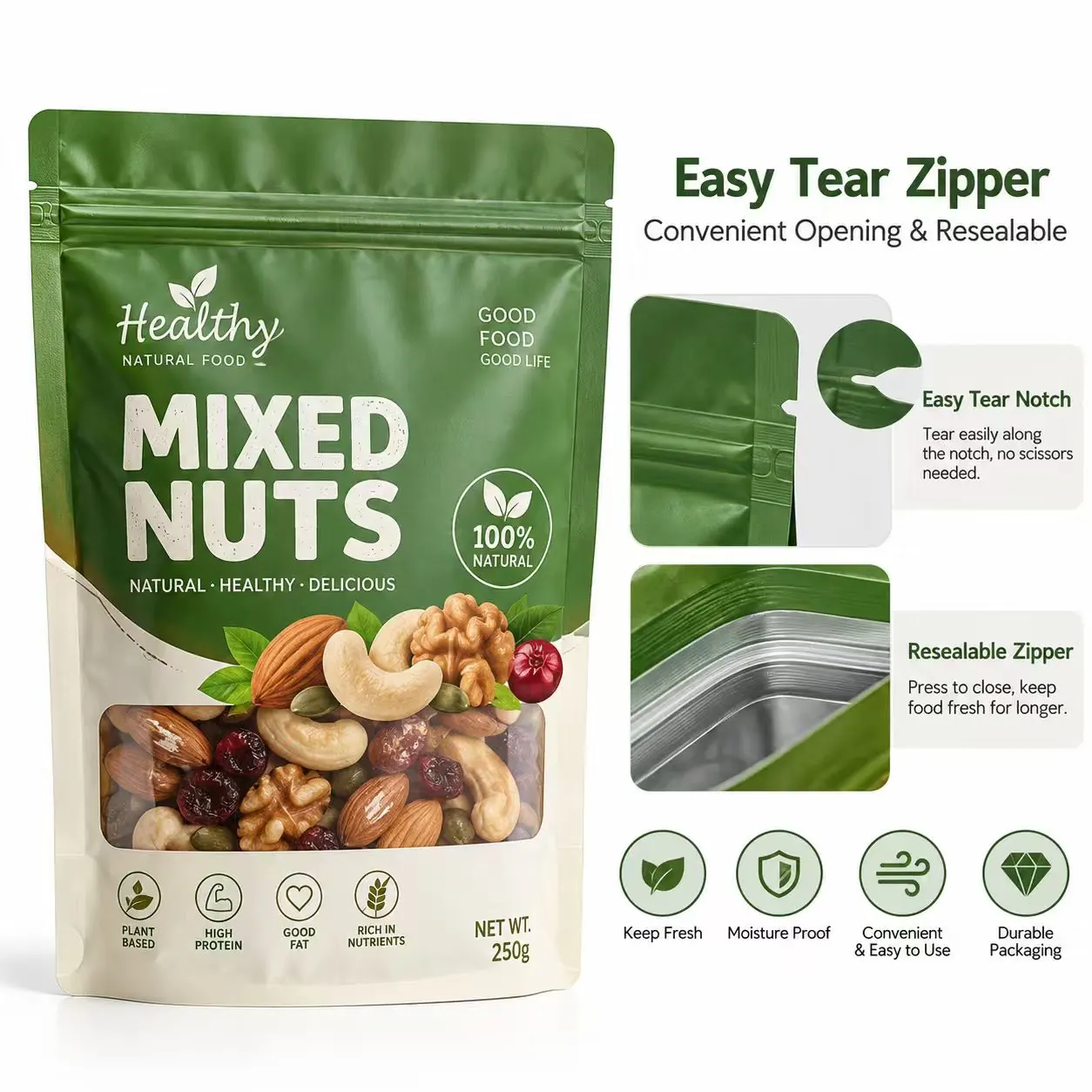
- Tear notch, hang hole, straw hole and zipper options
- Printed up to 10 colours, with matte, gloss or kraft-look finishes
Key Takeaways
Three-Side-Seal Pouches at a Glance
- The lowest-cost flexible format per unit — minimal film use and high line speed.
- Best for small fills: roughly 10 g to 500 g, including single-serve portions and sachets.
- The flat profile stores and palletises in far less space than stand-up pouches of the same count.
- Tear notch, hang hole, straw hole and zipper are all available depending on the pouch width.
- MOQ 100–500 pcs per design, with several designs runnable on one order to spread setup cost.
Format
Where the Flat Profile Wins
Three-side-seal pouches trade shelf presence for efficiency. Because there is no gusset and no base, the pack uses the least film of any pouch format, runs fastest on the filling line and stores flat — which matters when you are shipping hundreds of thousands of units in cartons.
That makes the format the natural choice for single-serve portions, sampling programmes, multipack components and lower-priced retail lines where the pack does not have to stand up by itself. Hung on a pegboard, or laid in a display tray, the pouch still shows a full front panel of artwork.
The format is also the easiest way to test a new product. Smaller fills mean smaller trial quantities, and several designs can be printed on a single order to spread the setup cost across a range.
Comparison
Three-Side-Seal vs. Stand-Up vs. Flat-Bottom
| Three-side-seal | Stand-up pouch | Flat-bottom pouch | |
|---|---|---|---|
| Relative unit cost | Lowest | Baseline | Highest |
| Typical fill range | 10 g – 500 g | 50 g – 2 kg | 200 g – 5 kg |
| Shelf presence | Needs a tray or pegboard | Stands on shelf | Stands square, five panels |
| Storage volume | Lowest of the three | Medium | Medium |
| Best for | Single-serve, samples, multipacks | Snacks, coffee, powders, treats | Premium coffee, protein, pet food |
Specifications
Build Options
| Item | Standard options |
|---|---|
| Material structure | PET/PE · PET/VMPET/PE · PET/AL/PE · kraft/PE · recyclable mono-material PE |
| Total thickness | Typically 60–120 micron, matched to fill weight and the protection the product needs |
| Sizes | From roughly 60 × 100 mm sample sachets up to 500 g packs, plus fully customized dimensions |
| Printing | Rotogravure and flexographic, up to 10 colours; matte, gloss, soft-touch or kraft-look |
| Closures | Tear notch, hang hole, straw hole, rounded or straight corners, zipper on wider formats |
| MOQ | 100–500 pcs per design; multiple designs can run on one order |
| Customized samples | 5–7 days · US$120 for 1–2 pcs · print film fee waived |
| Compliance | FDA 21 CFR and EU 10/2011 food-contact reports; produced under BRCGS Issue 7 (Grade B) |
Running a sampling programme or a multipack? Tell us the range and we will quote the designs together so the setup cost is shared.
Applications
Common Uses for Three-Side-Seal Pouches
Single-serve portions
Sauces, dressings, condiments and portion packs for foodservice and travel.
Sampling & trial packs
Low-cost, small-quantity runs for new products and new markets.
Confectionery
Candy, chocolate pieces and small snacks with a hang hole for pegboard display.
Coffee & tea samples
Trial-size packs that sit alongside a brand’s larger retail formats.
Nuts, seeds & dried fruit
Small-portion healthy snacks with a metallized barrier for freshness.
Non-food sachets
Wipes, granules and small-format household products on the same equipment.
Sealing
Seal Quality Is the Whole Specification
On a flat sachet the seal is the product. There is no gusset or base to absorb stress, so seal width, seal temperature, dwell time and pressure all have to be matched to the film structure and to whatever the pack will experience in transit.
We confirm the seal window against your filling equipment before production, then verify it in-line and again on finished pouches. For food and beverage applications the structure is produced under our BRCGS Issue 7 (Grade B) system, with FDA 21 CFR and EU 10/2011 food-contact test reports supplied on request.
If your product contains oils, acids or fine powders, mention it at the quotation stage — those three categories are the most common causes of seal contamination and channel leaks, and the film choice can be adjusted to compensate.
FAQ
Three-Side-Seal Pouches — Common Questions
What is a three-side-seal pouch?
A flat pouch sealed on three edges, with the fourth edge left open for filling. It is the simplest flexible pack to make, which makes it the lowest-cost format per unit and the standard choice for single-serve portions and samples.
What fill sizes does it suit?
Roughly 10 g to 500 g. The flat profile holds small portions efficiently, and it palletises and stores in far less space than a stand-up pouch of the same count.
Can it be resealable?
On wider formats yes — a zipper can be fitted. For narrow single-serve sachets the usual closures are a tear notch, a hang hole or a straw hole rather than a zipper.
Is it food-contact compliant?
All structures are produced under our BRCGS Issue 7 (Grade B) system, with FDA 21 CFR and EU 10/2011 food-contact test reports available for food and beverage applications.
What is the MOQ?
100–500 pcs per design. Because the format uses less film, three-side-seal pouches are often the cheapest way to test a new product or a new market.
Can you print small runs economically?
Yes. Low-MOQ printing is one of our specialties, and you can also run several designs on one order to spread the setup cost — useful for sample kits and multipacks.
Next Step
Test a Product Without Committing to Volume
Three-side-seal pouches are the cheapest way to put a new product in front of buyers. Send us the fill weight and the pack you are replacing and we will quote the trial quantity.
Last updated: September 2026