
Customized Side-Gusset Bags
Side-gusset bags are the classic format for coffee, tea and powders: two vertical gussets let a flat bag expand to hold 250 g to 1 kg of dense product, while the pack stays compact and rectangular. One-way valves and tin ties are fitted as standard options.
Key Features
- The classic 250 g – 1 kg format for whole-bean and ground coffee
- Two side gussets expand capacity without a wide base
- One-way degassing valve and tin-tie or clip reclosure
- High-barrier metallized or foil laminates for roast freshness
Key Takeaways
Side-Gusset Bags at a Glance
- Side gussets let a flat bag expand to a large fill without a wide base — the classic 250 g–1 kg coffee pack.
- Standard for whole-bean and ground coffee, loose-leaf tea, matcha and milk powder.
- A one-way valve plus tin tie keeps roast fresh and the bag reclosable; a zipper can be fitted instead.
- Two large printable faces plus the folded sides give room for branding and brewing or preparation notes.
- MOQ 100–500 pcs per design, with printed samples in 5–7 days.
Format
Why the Format Survived Every Trend
Side-gusset bags predate almost every other flexible format, and they survive because they are efficient. The gussets add capacity without adding base width, the filled bag is dense and rectangular, and it stacks into cartons and on shelf with minimal wasted space.
For coffee, the format is deeply familiar to buyers: a valve on the front face, a folded base, and a rolled top held by a tin tie. That familiarity is worth something on shelf — consumers read the pack as coffee before they read a single word of the artwork.
If you want maximum shelf presence and five printable panels, a flat-bottom pouch is the upgrade path. If you want the lowest cost per kilogram packed, a flat pillow bag or three-side-seal pouch may suit. Side gussets sit in the middle — which is exactly why so many roasters and tea brands stay there.
Comparison
Side-Gusset vs. Stand-Up vs. Flat-Bottom
| Side-gusset bag | Stand-up pouch | Flat-bottom pouch | |
|---|---|---|---|
| Typical fill | 250 g – 1 kg | 50 g – 2 kg | 200 g – 5 kg |
| Packed density | Highest of the three | Medium | Medium |
| Shelf presence | Familiar, compact | Stands on shelf | Best — five panels |
| Coffee extras | Valve + tin tie standard | Valve + zipper | Valve + zipper or tin tie |
| Relative cost | Baseline | Baseline to slightly higher | Highest |
Specifications
Build Options
| Item | Standard options |
|---|---|
| Material structure | PET/VMPET/PE · PET/AL/PE · kraft/PE · mono-material PE for recyclability |
| Total thickness | Typically 90–160 micron, matched to fill weight and barrier target |
| Sizes | 100 g to 1 kg and larger, plus fully customized dimensions from your dieline |
| Gusset depth | Matched to fill volume so the bag keeps a clean rectangular profile |
| Printing | Rotogravure and flexographic, up to 10 colours; matte, gloss or kraft-look finish |
| Closures | One-way degassing valve, tin tie, clip, resealable zipper, tear notch |
| MOQ | 100–500 pcs per design for standard structures |
| Customized samples | 5–7 days · US$120 for 1–2 pcs · print film fee waived |
| Compliance | FDA 21 CFR and EU 10/2011 food-contact reports; produced under BRCGS Issue 7 (Grade B) |
For coffee we will check the valve placement against your filling and degassing timeline, so the pack vents correctly on the shelf.
Applications
Where Side-Gusset Bags Are Used
Whole-bean & ground coffee
250 g to 1 kg with a one-way valve and tin tie — the classic roaster pack.
Loose-leaf tea & matcha
High-barrier metallized structures that protect delicate aroma.
Milk powder & formulas
Dense fills with a foil barrier for long shelf life.
Protein & powders
1 kg formats with a zipper as an alternative to wide flat-bottom packs.
Rice & grains
Compact rectangular packs that stack cleanly in cartons.
Pet treats
Mid-size packs with a resealable zipper for repeat use.
Freshness
Valve, Barrier and the First 72 Hours
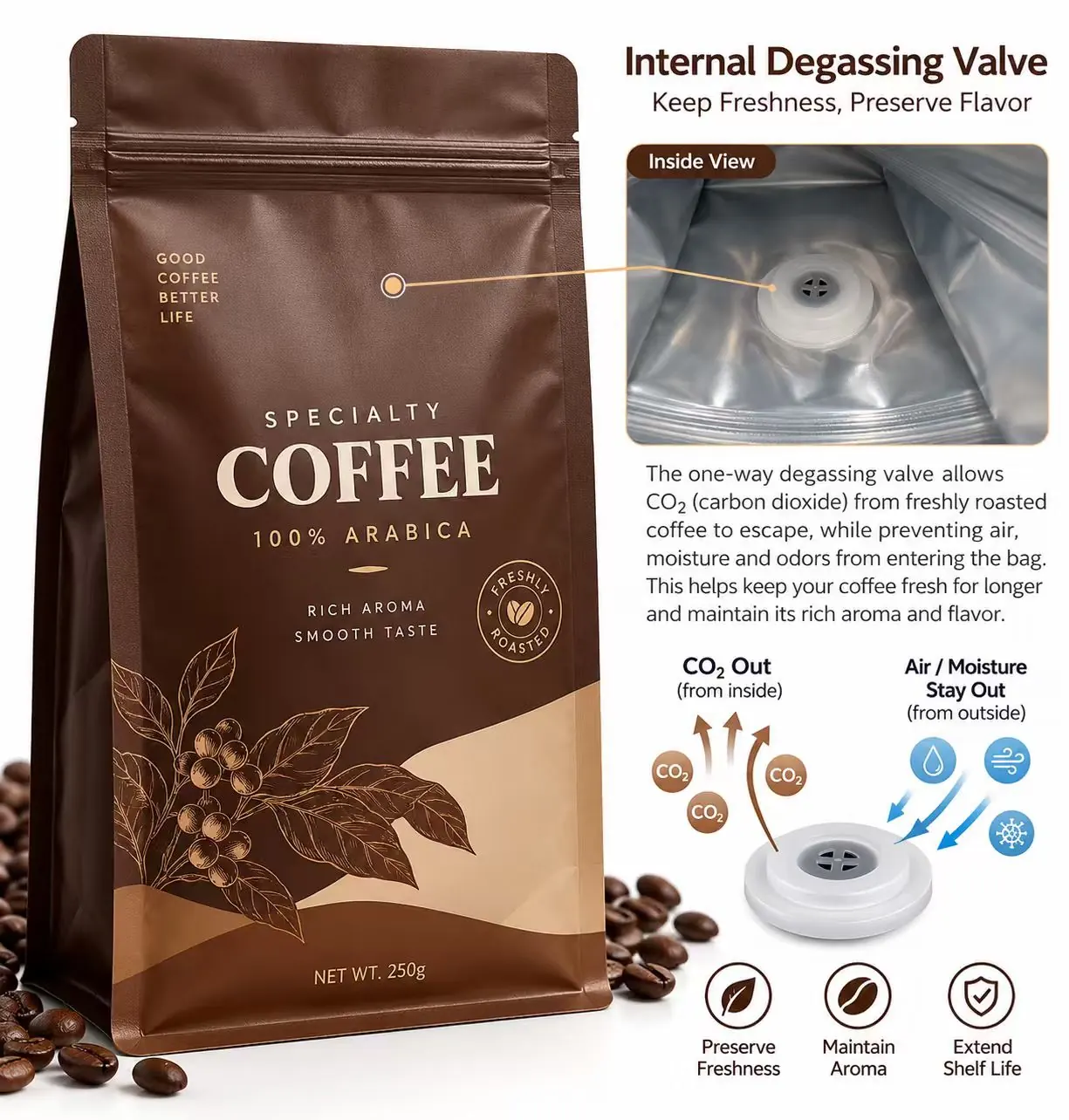
Freshly roasted coffee keeps releasing carbon dioxide for days. Seal it in a barrier film with no valve and the bag swells or bursts; leave it in open air and aroma oxidises away. The one-way valve solves both — CO₂ escapes, oxygen stays out — which is why it is standard equipment on every coffee bag we make.
The barrier layer determines how long the roast stays saleable. A metallized PET layer blocks light and slows oxygen ingress; an aluminium foil layer goes further and is the usual choice for long storage or export shipping. We will ask how long your roast sits before it reaches the consumer, and propose the structure from there.
Documentation travels with the pack: FDA 21 CFR and EU 10/2011 food-contact test reports, produced under our BRCGS Issue 7 (Grade B) system, available on request.
FAQ
Side-Gusset Bags — Common Questions
What is a side-gusset bag?
A bag with two vertical gussets folded into the sides, so a flat bag expands to hold a larger fill. It is the classic format for 250 g to 1 kg whole-bean and ground coffee, loose-leaf tea and milk powder.
Can it have a one-way valve and tin tie?
Yes — that combination is standard for coffee. The valve releases CO₂ without letting oxygen in, and the tin tie (or a clip) keeps the bag rolled closed after opening. A zipper can be fitted instead of, or alongside, the tin tie.
Why do roasters still choose side gussets over stand-up pouches?
Density and stacking. A filled side-gusset bag is compact and rectangular, so it ships and shelves efficiently, and the format has decades of familiarity behind it. Stand-up pouches win on shelf presence; side gussets win on density and unit cost.
What sizes do you produce?
From small 100 g packs to 1 kg and larger, plus fully customized dimensions from your dieline. The gusset depth is matched to the fill volume so the bag keeps a clean rectangular profile.
What is the MOQ?
100–500 pcs per design for standard structures. Customized printed samples take 5–7 days at US$120 for one to two pieces, with the print film fee waived.
Which barrier suits roasted coffee?
A metallized PET layer (VMPET) blocks light and oxygen; aluminium foil gives the strongest barrier for long storage. Both pair with a one-way valve. Tell us your roast-to-shelf timeline and we will propose the structure.
Next Step
Tell Us the Roast, We Will Match the Pack
Send the fill weight, roast-to-shelf timeline and the format you are replacing. We will propose the structure and closures, with samples in 5–7 days.
Last updated: September 2026