
Blog
Pet Food Packaging Bags: Sizes, Barrier and Puncture
Pet food packaging is decided by three things: the fill weight, the product's fat content, and whether the pack has to stand on a shelf or survive a warehouse. Fat content is the constraint buyers most often miss, because oils attack the sealant layer and the failure appears as a leak rather than as a barrier problem. This guide covers format against fill weight, the structures that tolerate fat, and the closure and handle decisions that keep a large bag intact.
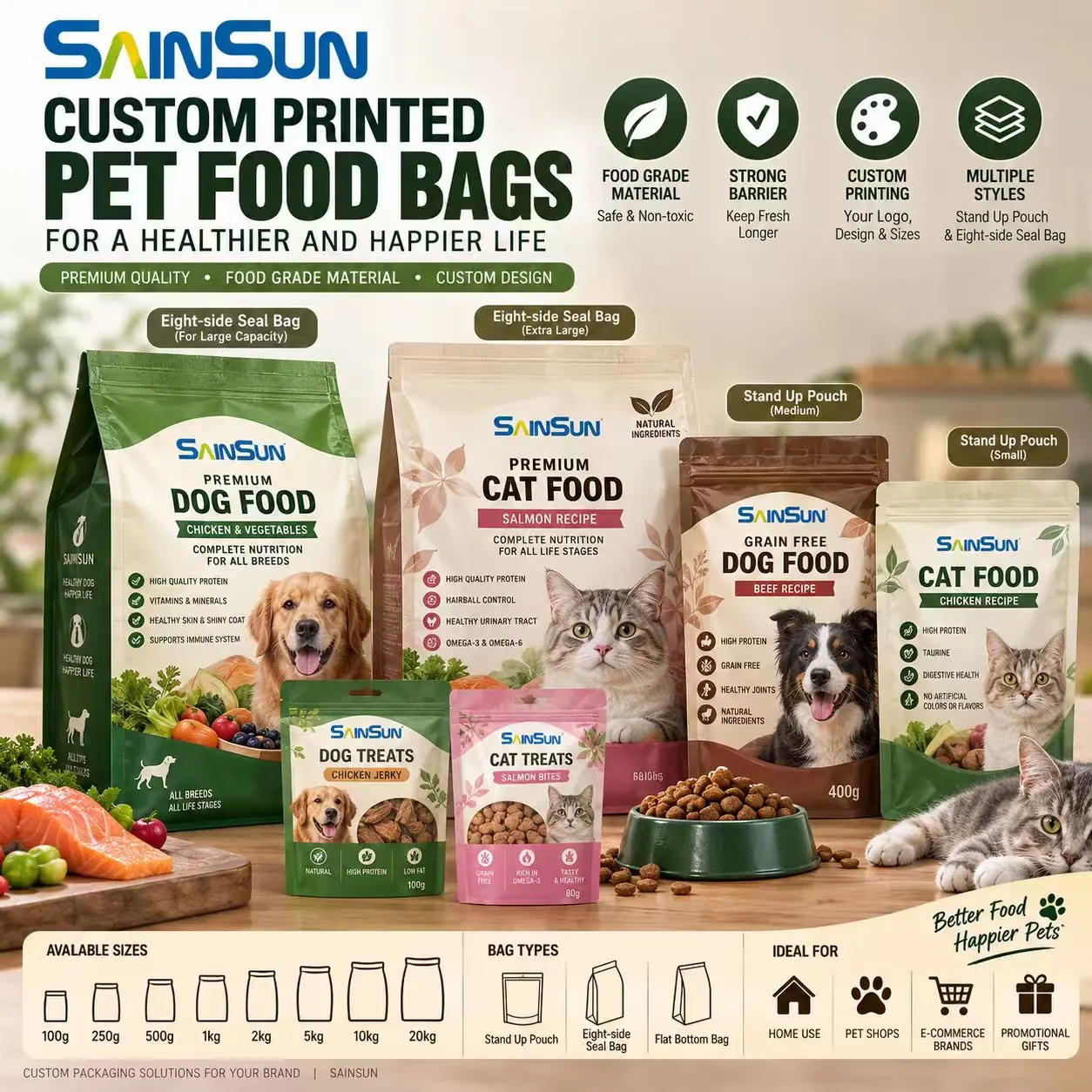
Pet food packaging looks like human food packaging with a different picture on the front. It is not. The bag is typically larger and denser than a food pouch, it gets stacked and dropped in a way a snack bag does not, it has to survive being reopened daily for a month, and the contents are often greasy and abrasive. Those four facts reorder the design priorities.
This guide covers what actually decides whether a pet food bag performs: the fill-size families behind common pack weights, why puncture and grease resistance outrank barrier for most pet products, the closure and handle details that generate complaints when they are wrong, and how to run a first order without over-committing on film.
Four product types, four different bags
Pet food is not one category. The pack requirements diverge sharply:
- Dry kibble — the volume category. Large formats, heavy fills, and a bag that must reseal reliably for weeks of daily use. Grease resistance and seal strength matter more than a high oxygen barrier.
- Treats and chews — smaller packs, higher value per gram, often a premium finish. Treated more like a human food pack, with a stronger emphasis on shelf presence and print quality.
- Wet food and pouches — retort-sterilized for ambient shelf stability, or chilled and frozen formats. These follow the retort rules, not the kibble rules.
- Frozen and raw — freezer-to-thaw packs, where the film has to stay flexible at frozen temperature and the seal has to hold through the temperature swing. Vacuum and modified-atmosphere variants are common.
Getting this wrong is the most expensive mistake in the category: a structure optimized for a snack pouch gets used on 10 kg kibble and fails on puncture before it ever reaches a shelf.
Fill sizes: what each pack weight actually means
Pet food bags cluster into recognisable families. These are the reference bands we quote against — exact dimensions are always set by bulk density, fill method and the case you want:
| Pack family | Typical fill | Format that usually wins |
|---|---|---|
| Sample / trial | 50–200 g | Three-side-seal sachet, sometimes with a hang hole |
| Small retail | 500 g – 1 kg | Stand-up pouch with zipper |
| Core retail | 2–4 kg | Stand-up or flat-bottom pouch with handle, or side gusset |
| Large retail / multi-pack | 5–10 kg | Side-gusset or flat-bottom bag with reinforced handle |
| Bulk / breeder | 10–25 kg | Heavy-duty side-gusset or woven-hybrid bag |
The number on the front is a weight; the bag is a volume. Kibble bulk density varies by kibble size, shape and coating, so two products both labelled 3 kg can need different bag dimensions. If you are matching an existing bag, send the physical dimensions rather than the fill weight — and see why the weight on the front is not the size you order for the general version of this trap.
Where pet food bags actually fail
When a pet food bag fails, the cause is almost never the barrier. Four failure modes account for most complaints:
Puncture and abrasion
Kibble has hard, angular edges, and a 10 kg bag of it is heavy enough that those edges press against the film under its own weight during stacking and handling. In transit, bags rub against each other and against pallet edges. The film needs enough mechanical toughness — usually a nylon or PET structural layer — to survive that without pin-holing. Our pet food packaging page covers where puncture risk actually comes from in the format.
Grease and oil migration
Kibble and treats are often coated with fat or oil, and that coating attacks the pack from the inside. A sealant layer that performs well on a dry snack can soften, delaminate or lose seal strength under a greasy fill. The sealant has to be chosen for the fat content, not just the food-contact rules.
Reseal failure after repeated use
A 5 kg bag is opened and closed daily for weeks. A zipper that is fine for five open-close cycles is not fine for fifty. Zipper profile, track strength and the film's stiffness at the zipper zone all decide whether the bag still closes properly in week four, which is when the product starts going stale and the customer notices.
Handle and lift failure
Large formats are lifted by the handle, and often by the handle alone while full. Handle attachment method, seal width at the handle and the film's tear resistance decide whether the bag survives being carried. Handles are also where print registration is easiest to get wrong, so the handle zone is often best left unprinted or deliberately quiet.
Barrier: it still matters, but it is not the first question
Barrier matters — particularly for premium kibble with added oils, freeze-dried treats and any product with a long ambient shelf life. But for most pet food the sequence is:
- Mechanical integrity first — toughness, puncture resistance, seal strength at fill and storage temperature, handle strength.
- Grease resistance second — the sealant layer and the lamination adhesive.
- Resealability third — zipper choice, sized to how often the pack is opened.
- Barrier fourth — matched to the shelf-life target, without over-engineering the structure.
Inverting that order produces a pouch with an excellent oxygen barrier that burst in the warehouse. Where the product does need a real barrier — freeze-dried raw, high-value treats, extended ambient shelf life — the structure moves toward metallized PET or foil-containing laminates, and the trade-off against recyclability has to be made deliberately. The trade-off against recyclability is a separate decision, and it is better made deliberately than by default.
Closures, handles and features
- Zippers — press-to-close for lighter packs, slider or high-track-strength zippers for large formats opened daily. A zipper under-specified for the opening frequency is the single most common after-sale complaint.
- Handles — die-cut or attached, sized to the loaded weight. A die-cut handle in the top seal is cheap and effective up to a point; heavier formats need a reinforced or attached handle.
- Vents — rarely needed for dry kibble, but relevant for some treats and for any pack that generates gas. Where the product must degas, the principles are the same as for coffee bags with a one-way valve.
- Windows — a clear window sells kibble by showing it, at the cost of light protection in that zone. Common on premium and specialty lines.
- Finishes — matte and soft-touch read as premium on treats; glossy and metallized read as value and barrier on mainstream kibble.
Running a first order
Pet food bags do not require a 50,000-piece commitment to start:
- Samples first. Stock samples are free (courier at cost). Customized prototypes — your dimensions, structure, zipper and print concept — are a small setup figure for 1–2 pieces, typically 5–7 days.
- Digitally printed short runs from around 100–500 pieces suit a launch, a new recipe or a subscription test, with no cylinder cost.
- Gravure runs start in the low thousands, where unit price drops sharply and cylinder investment pays back.
- Qualify the pack on your own fill. Kibble settles differently on different fillers, and the zipper and handle zones behave differently at production speed than in a sample room. Fill 500–2,000 trial bags at line speed before releasing a full order.
What to send us
- Product type (dry kibble, treats, wet, frozen/raw), kibble size and coating
- Fill weight and bulk density, or the dimensions of the bag you are matching
- Format: stand-up, flat-bottom, side-gusset, sachet, roll film for your line
- Opening frequency: how often a customer will reopen the pack
- Closure and handle requirement, and the loaded weight the handle must carry
- Barrier and shelf-life target, and whether recyclability is a requirement
- Print: colours, finish, artwork status, and target quantity
We make the full range of pet food formats; the format-specific detail is on the pet food packaging bags page, and general food format and material options are in food packaging pouches: types, materials and customized options.
Sources and standards
Primary references for food-contact rules and packaging performance referred to in this guide:
- 21 CFR Part 177 — Indirect food additives: polymers (US eCFR)
- EU Regulation 10/2011 — Plastic materials in contact with food (EUR-Lex)
- FDA — Animal food and feeds (US FDA)
- BRCGS Global Standard for Packaging Materials (BRCGS)
Frequently asked questions
What size bags do pet food products come in?
Common families are 50-200 g trial sachets, 500 g to 1 kg small retail stand-up pouches, 2-4 kg core retail pouches with a handle, 5-10 kg large or multi-pack bags, and 10-25 kg bulk formats. Exact dimensions depend on bulk density and kibble shape, not the weight on the front.
Which film structure is best for dry kibble?
One with enough mechanical toughness to resist puncturing from hard kibble edges under load - usually a structure containing nylon or PET - plus a sealant layer chosen for the fat and oil coating of the kibble. Barrier matters, but puncture resistance and grease resistance come first for most dry pet food.
Why do large pet food bags tear or puncture?
Kibble has hard, angular edges and a 10 kg bag is heavy enough that those edges press against the film under its own weight in stacking and transit. The film needs a tough structural layer, and the pack is drop and compression tested after filling, not only at room temperature in a sample room.
How strong does a zipper need to be on a pet food bag?
It depends on how often the customer reopens the pack. A 5 kg bag opened daily for weeks needs a higher-track-strength zipper than a small treat pouch. An under-specified zipper is the most common after-sale complaint in the category.
Do pet food bags need a vent?
Rarely for dry kibble. Vents are relevant for products that generate gas or need to degas, and for packs that will be microwaved or sterilized. Where the product must degas, the design logic is the same as for coffee bags with a one-way valve.
What is the minimum order for customized pet food bags?
Digitally printed pouches run from around 100-500 pieces per design with no cylinder cost, which suits a launch or a new recipe. Gravure runs start in the low thousands where unit price drops sharply. Customized prototypes of 1-2 pieces are available before any print run.
Have a pack like this to quote?
Send the product, how it will be filled and stored, the format or an area to advise on, and your quantity. You get back a named structure, a colour count, a minimum tier and a line-by-line price — usually within one working day.