
Blog
Frozen Ready Meal Packaging: Freezer-to-Microwave Pouches
A frozen ready-meal pouch has to survive three things a shelf-stable pouch does not: expansion on freezing, impact while rigid, and a fill line that runs cold. The film structure is specified for low-temperature toughness first, because a laminate that is adequate at room temperature can crack at −18 °C. This guide covers the structures that hold at freezer temperature, the headspace that accommodates expansion, and the seal checks that matter when the product is frozen.
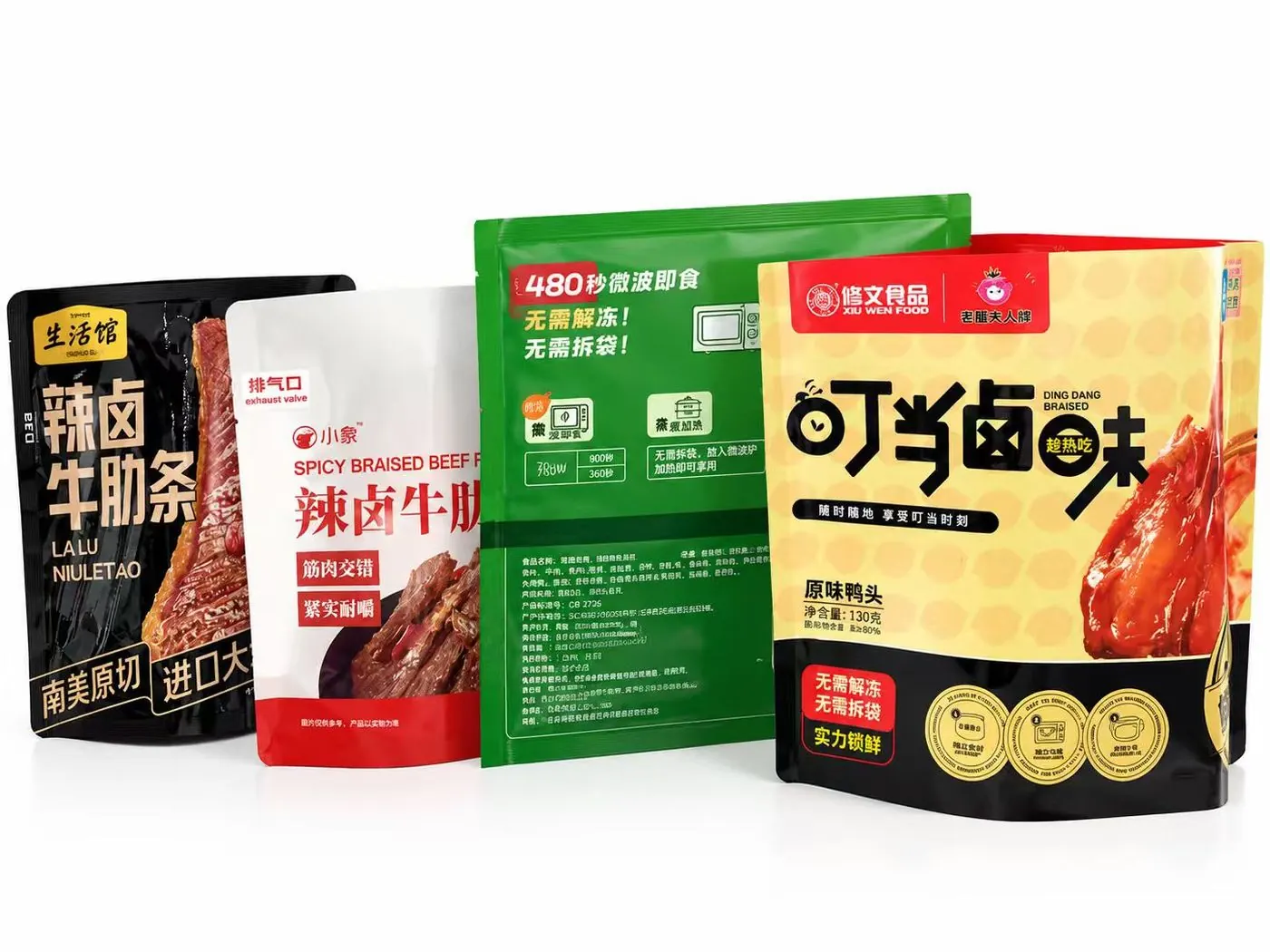
A frozen ready meal pouch has to do something no other food pack does: stay sealed through a temperature swing from about −20 °C to over 100 °C, on the same piece of film, without cracking, leaking, or failing in the microwave at the end of the journey. That range is the whole design brief.
Most packaging failures in this category happen at the two extremes, not in the middle. A pack that looked perfect at room temperature fails at −20 °C because the film became brittle and the seal cracked on the pallet; or it fails in the microwave because the structure was chosen for frozen storage and never reconsidered for steam. This guide covers both ends, and what to specify before you order.
The product path decides the structure
Before choosing a film, write down what actually happens to the pack. A frozen ready meal typically follows this route, and every step constrains the film:
- Fill — hot-fill, cold-fill, or frozen components assembled into the pouch. Hot-fill at 85–95 °C needs a structure that tolerates it; assembling frozen components does not.
- Seal — the seal has to be strong at fill temperature and remain intact at frozen temperature, which are different requirements.
- Freeze — the pack goes to −18 to −20 °C or below. Film stiffness, seal flexibility and the food's expansion all change here.
- Store, stack, ship — compressive load on a pallet, drop and vibration in transit. This is where flex cracking and seal-edge failure show up.
- Reheat — the consumer opens the freezer, puts the sealed pack in the microwave, and expects it to vent, cook evenly and not burst.
The mistake to avoid is qualifying the pack at one step and assuming the rest. A structure tested only in the microwave is not a frozen-meal pack; a structure tested only at frozen storage is not a microwave pack.
Structures that survive the full range
Frozen ready meal packs are metal-free — foil arcs in a microwave — so the barrier has to come from the polymer layers instead. The common builds:
- PET / PE — the baseline frozen-to-microwave structure. PET gives temperature stability and clarity, PE does the sealing. Adequate for shorter shelf-life frozen meals.
- PET / PP — higher temperature tolerance on both ends, used where the cook cycle is long or the fill is hot. Better dimensional stability in the microwave than PE-sealed equivalents.
- NY / PE — adds puncture resistance for sharp-edged or bone-in contents, and improves flex-crack resistance at frozen temperature. The nylon layer is doing real work here, not decoration.
- Barrier-enhanced builds — EVOH or oxide-coated layers where the product needs a genuine oxygen barrier for a longer frozen shelf life or an ambient variant. This is what replaces the foil you cannot use, and it is usually the most expensive line in the structure.
Two film facts drive most frozen-pack failures, and both are worth understanding before you approve a sample:
Flex cracking. At frozen temperature, polymer films become stiffer and less forgiving. Repeated flexing over a pallet edge, or a bag that is handled roughly in a cold store, can develop micro-cracks in the barrier layer. The pack still looks fine and still leaks nothing at first — but the oxygen barrier is now compromised, and the shelf life you validated is no longer the shelf life you ship. Nylon-containing structures resist this better than all-PE builds.
Seal behaviour across the range. The seal you set at fill temperature must survive at −20 °C. A seal that is slightly under-cooked may hold at warm temperatures and open at frozen ones, which is exactly the kind of failure that reaches a customer instead of a quality lab. Seal strength is verified at both ends of the temperature range, not just the one that is convenient to test.
If the pack is microwaved sealed, venting comes first
Many frozen ready meals are reheated in the sealed pouch. That makes the vent a structural requirement, not a feature. The pack must release steam at a designed pressure instead of failing at the weakest seal edge.
The numbers that govern it — activation pressure, the relationship between vent and seal strength, and the film behaviour that makes laser perforation reliable — are covered in self-venting microwave pouches: what to specify. For a frozen pack specifically, the extra requirement is that the vent must not activate during freezing, stacking or transport. A vent that opens early in a cold chain is a leak, not a feature, and it is the failure mode that catches brands out because nothing goes wrong until the food arrives spoiled.
Single portion versus bulk: format follows the customer
- Single-portion pouches — the retail and convenience format. Three-side-seal or stand-up pouches, usually 200–400 g, sized so the pack sits flat and cooks evenly. Often the format where a self-venting design earns its cost.
- Multi-portion and family packs — larger stand-up pouches or side-gusset formats. More steam per cook, so the vent spec and the film thickness change with the fill weight.
- Foodservice bulk pouches — 1–3 kg packs for catering, reheated in a water bath or a combi oven rather than a domestic microwave. Different process, different structure, usually no consumer vent at all.
- Tray lidding — where the meal is presented in a rigid or semi-rigid tray and the film is the lid. Vent patches are common here rather than laser perforation.
Format decisions here are driven by the reheating method and the customer, not by shelf appearance alone. A pack designed for a water bath and a pack designed for a domestic microwave are not interchangeable, and the enquiry should say which one you are selling into.
What to test before a bulk order
- Seal strength at both temperature extremes — fill temperature and frozen temperature.
- Flex-crack and drop testing after freezing, to prove the barrier survives handling, not just storage.
- Vent activation (if microwaveable sealed) at the real fill weight, including a check that it does not activate during transport simulation.
- Real-oven cook performance: even heating, no cold spots, food reaches serving temperature in the stated time, pack holds shape.
- Post-cook integrity — no seal failure, no leakage, and the pack opens cleanly for the consumer.
All of these run on samples made from the exact production structure with your own food at your own fill weight. Our microwave-ready bags page explains what we validate before a run, and the ready meal packaging page covers the category context — shelf-stable retort versus freezer-to-microwave.
What to send us
- Product type and composition, including fat, salt and acid content
- Fill weight and fill temperature (hot, cold or frozen components)
- Storage: frozen, chilled or ambient — and the shelf life target
- Reheat method: sealed in a domestic microwave, water bath, combi oven, or not reheated in pack
- Format: pouch, stand-up, tray lidding, roll film for your line
- Proof requirements: whether you need to add a “do not pierce” or vent instruction, and print status
- Quantity per design and target annual volume
If the product is also shelf-stable and sterilized rather than frozen, the structure moves to a foil-based retort laminate and the rules change — see microwave cooking bags and retort pouches: how to choose. General format and material options across food packaging are covered in food packaging pouches: types, materials and customized options.
Sources and standards
Primary references for frozen-pack performance and food-contact rules referred to in this guide:
- ASTM F1140 — Burst testing of unrestrained flexible packages (ASTM)
- ASTM F1307 — Oxygen transmission rate through dry packages (ASTM)
- 21 CFR Part 177 — Indirect food additives: polymers (US eCFR)
- EU Regulation 10/2011 — Plastic materials in contact with food (EUR-Lex)
Frequently asked questions
Which film is used for freezer-to-microwave ready meal pouches?
Metal-free laminates that survive the full range: PET/PE or PET/PP as the baseline, NY/PE where puncture or flex resistance is needed, and EVOH or oxide-coated barrier builds for longer shelf life. Aluminium foil cannot be used because it arcs in a microwave.
Why do frozen meal pouches fail at frozen temperatures rather than in the microwave?
Two reasons. Films become stiffer and less forgiving when frozen, so flex cracking can damage the barrier even though the pack still looks intact. And a seal set for fill temperature may not hold at -20 C, opening in the cold chain. Both are tested at the temperature extremes, not at room temperature.
Can a frozen ready meal be reheated in the sealed pouch?
Yes, if the pack is designed for it. That makes a vent a structural requirement: the pack must release steam at a designed pressure instead of failing at the weakest seal edge. The vent must also be engineered not to activate during freezing, stacking or transport.
What is the shelf life of a frozen ready meal in a pouch?
It depends on the structure, the food and the storage conditions. Longer frozen shelf life needs a genuine oxygen barrier, which in a metal-free microwaveable pack means EVOH or oxide-coated layers rather than foil. Validate shelf life on samples made from the exact production structure.
What tests should I ask for before a bulk order?
Seal strength at both temperature extremes, flex-crack and drop testing after freezing, vent activation at the real fill weight plus a transit simulation check, real-oven cook performance, and post-cook integrity. Test with your own food at your own fill weight, on the production structure.
Do you make single-portion and bulk frozen meal pouches?
Yes. Single-portion three-side-seal or stand-up pouches from around 200-400 g, larger multi-portion and family packs, and foodservice bulk pouches for water-bath or combi-oven reheating. Each format gets its own vent and thickness spec based on fill weight and reheat method.
Have a pack like this to quote?
Send the product, how it will be filled and stored, the format or an area to advise on, and your quantity. You get back a named structure, a colour count, a minimum tier and a line-by-line price — usually within one working day.