
Blog
Side-Gusset Pouches: Why Coffee Still Ships in a Paper-Form Bag
A side-gusset pouch survives because the gusset folds flat, fills deep, stacks square, and takes a valve and a tin tie without fighting the structure — which is why coffee still ships in one. It gives up shelf presence and front-face print area, so it is the right choice for dense products in cartons and the wrong choice for anything that has to sell itself while standing up. This guide covers what the format does well, how the gusset changes fill weight and stacking, where the valve and tin tie belong, and which products should never be packed in one.
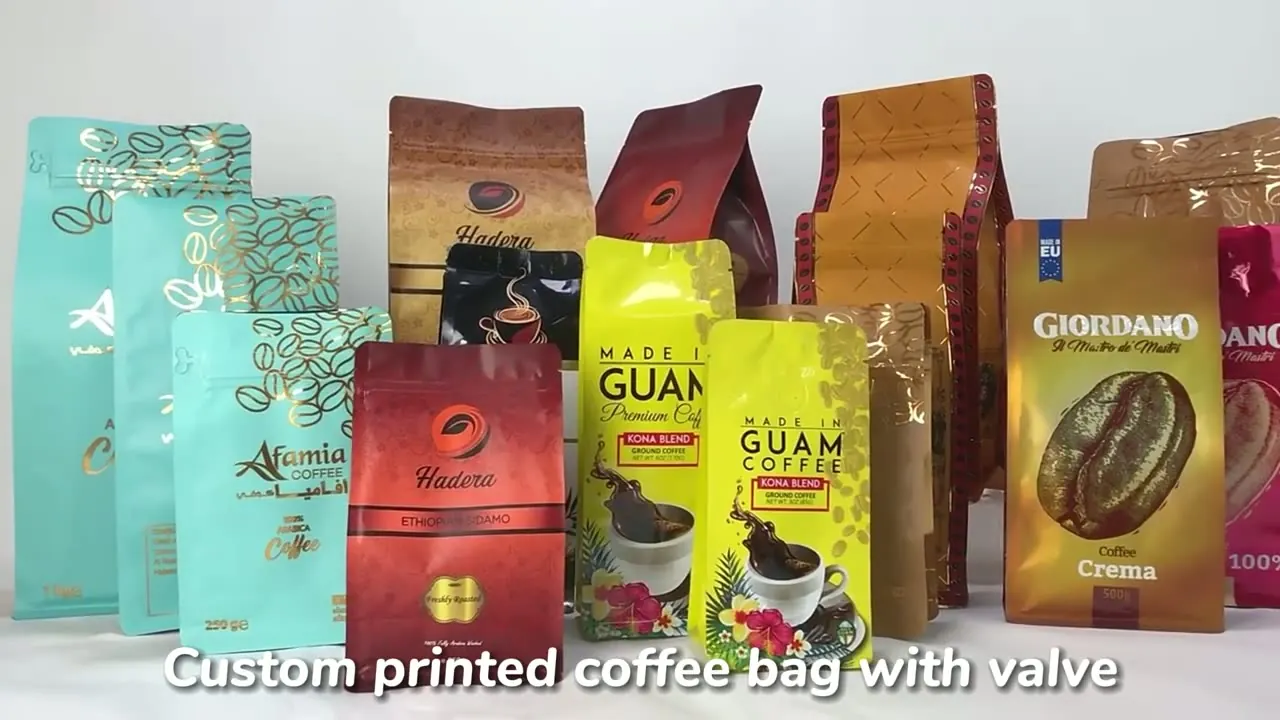
Coffee was sold in side-gusset bags long before the stand-up pouch existed, and a large share of the world's coffee still is. That is usually explained as tradition. It is not: it is the format doing three things at once that a stand-up pouch does less well - packing flat before fill, holding a tall narrow product, and taking both a one-way valve and a tin tie without a structural argument.
What a side-gusset pouch actually is
A side-gusset pouch - also called a block-bottom or pinch-bottom bag, or simply a gusset bag - is made from a tube of film with a gusset folded into each side, sealed across the top and bottom. Empty, it folds almost flat. Filled, the gussets open and the bag becomes a tall rectangular block with four printable faces: a front, a back, and two gussets.
That fold-flat property is the format's defining advantage and the source of everything else. It is why gusset bags ship and store empty in a fraction of the space a stand-up pouch occupies, and why a co-packer can hold a large stock of empty bags on a shelf rather than a pallet.
Three things the gusset does better
- Tall, narrow products. A 250 g or 500 g coffee bag is a tall block. A stand-up pouch of the same volume has a wide base and a shorter body, which changes how the pack reads on a shelf - and for coffee, the tall face is the category convention customers expect.
- Deep fill without a wide base. The gusset expands as the product fills it, so the bag accommodates a deep fill with a footprint that stays narrow. That keeps carton dimensions tight and shelves dense.
- A flat face for closures. A valve sits on the front panel of a gusset bag, and a tin tie folds over the top seam. Both are simple on a flat face and both need care on a shaped or tapered pouch.
Our side-gusset bags page lists the standard sizes; the format is also where most of the world's coffee bag production sits, for the reasons above.
The gusset is a print surface, and a stress point
Two gussets mean two extra printable faces - four panels in total, which is more print area than a flat pouch and comparable to a stand-up pouch. Brands use the gussets for brewing instructions, a specification table or a story panel, and it is one of the reasons a gusset bag can carry more information without crowding the front.
The same fold is also where the format needs discipline. The gusset crease is a fold line that takes repeated stress, and on a poor laminate it is where a pinhole appears first - particularly on a bag that has been filled to its limit. Film structure matters at the crease more than anywhere else on the pack, and a heavier sealant layer is the usual answer. The mechanisms are the same ones covered in why pouches leak, applied to a fold rather than a seal.
Fill weight, stacking and carton space
- Fill weight. Gusset bags scale from a few hundred grams to several kilos, and the format is limited mainly by the film structure rather than the geometry. A gusset bag at 1 kg is unremarkable; a stand-up pouch at 1 kg is a design challenge.
- Stacking. Filled, a gusset bag is a rectangular block and stacks predictably in a carton. Empty, it folds flat enough that storage is a non-issue.
- Carton space. Because the footprint stays narrow, carton dimensions are tight and the format usually ships more product per pallet than a stand-up pouch of the same fill.
The trade is presentation. A gusset bag standing on a shelf leans slightly unless the fill is firm and even, and a row of them looks less uniform than a row of flat-bottom pouches. For a brand selling on shelf presence alone, that matters; for coffee, the category has decided it does not.
Valve and tin tie on a gusset bag
A one-way valve lets carbon dioxide out of a freshly roasted coffee pack while keeping oxygen from getting back in, and its placement is a decision rather than a default: front panel, upper third, away from the seal. The reasoning behind placement, sizing and testing is set out in coffee bag degassing valves.
A tin tie is a folded metal strip inside a paper-look sleeve across the top. On a gusset bag it sits inside the top seam and folds over the compressed bag - which is why the format and the closure fit each other. On a stand-up pouch, a tin tie is possible but the tapered top makes the fold less clean.
Where a brand wants both resealability and a valve, the gusset bag is the format that carries both without a compromise. Combine it with a zipper and the top seam gets busier - worth confirming with a sample rather than on paper.
When not to use a side-gusset pouch
- Products that must stand unaided on a busy shelf. A flat-bottom pouch does this better.
- Very small doses. Under roughly 100 g the format's proportions stop making sense; a flat or a small stand-up pouch fits better.
- Products needing a wide display face. The tall narrow front gives less area for a hero image than a flat-bottom pouch of the same volume.
- Liquid or semi-liquid fills that need a stable base while open. A gusset bag standing open on a counter is less stable than a flat-bottom pouch.
Send us the product, the fill weight and the closures you need - valve, tin tie, zipper - and we will send a sample of the format that carries all of them without strain. The gusset bag is often the answer; it is worth confirming rather than assuming either way.
Frequently asked questions
Is a side-gusset pouch the same as a block-bottom bag?
Essentially yes. Block-bottom, pinch-bottom and gusset bag are all names for a tube with a gusset folded into each side and a sealed top and bottom. Which term a supplier uses is partly regional; ask for a dieline and a sample, because the names do not fully standardise the dimensions.
Why is coffee still packed in gusset bags rather than stand-up pouches?
Three practical reasons: the tall narrow face is the category convention, the format folds flat before fill so empty bags store compactly, and a valve and a tin tie both sit cleanly on a flat front panel and a flat top seam. Stand-up pouches work for coffee too, usually at smaller retail formats.
Can a side-gusset pouch take a zipper?
Yes, but a zipper plus a tin tie plus a valve makes a busy top seam, and the geometry needs checking on a sample. If resealability is the priority rather than the tin-tie closure, a zipper alone is the simpler specification.
Where do gusset bags fail first?
At the gusset crease, especially on a heavy fill. The fold line takes repeated stress and is where a pinhole appears first on a light laminate. A heavier sealant layer is the usual fix, and it is worth specifying before the fill weight pushes the limit.
How many panels can we print on a gusset bag?
Four: front, back and both gussets. That is more than a flat pouch and comparable to a stand-up pouch, which is why brands use the gussets for brewing instructions or a specification table without crowding the front panel.
Have a pack like this to quote?
Send the product, how it will be filled and stored, the format or an area to advise on, and your quantity. You get back a named structure, a colour count, a minimum tier and a line-by-line price — usually within one working day.