
Blog
Mono-Material Recyclable Pouches: What Changes on Your Line
A mono-material pouch is a recyclable pouch only if the whole pack — film, zipper, valve and label — is one polymer family, and swapping the laminate for mono-PE changes stiffness, seal window, barrier and line speed at the same time. The trade that decides most projects is oxygen barrier: a mono-PE structure that passes a 6-month snack test usually needs an EVOH or coating layer, and that layer is the piece most likely to fall outside the recycling stream. This guide covers what moves on the filling line, how to read a recyclability claim, and the pilot that finds the seal-window problem before a launch does.
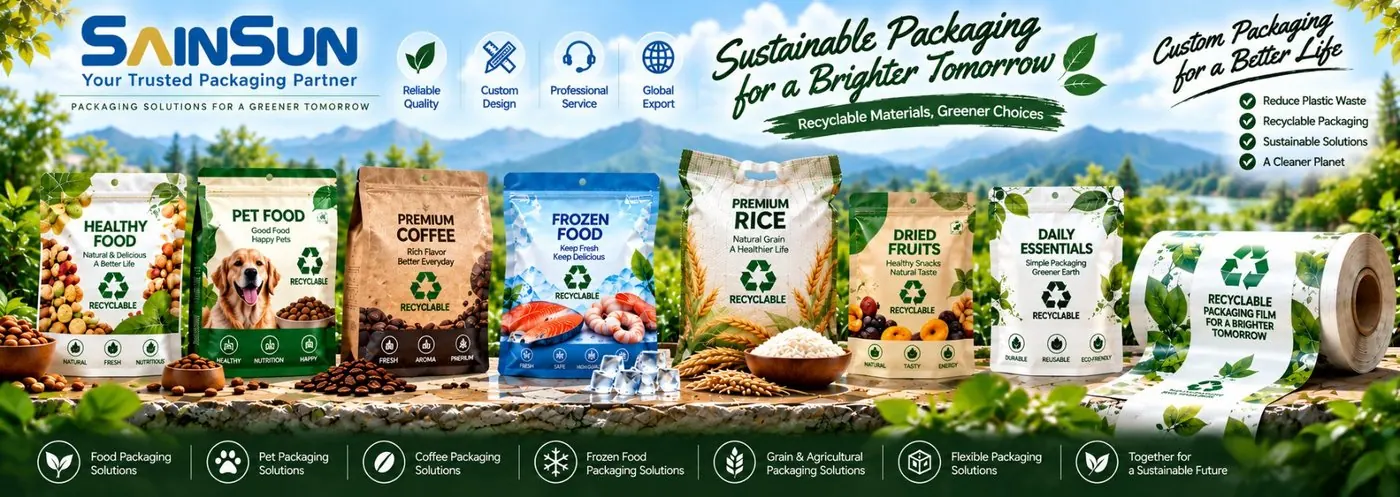
Recyclability in flexible packaging has moved from a marketing line to a design requirement, and the design requirement has a practical shape: move a multi-material laminate toward a single polymer family so that the pack can be sorted and reprocessed rather than sent to energy recovery.
That change is real and worth making. It is also not a material swap. When you replace a foil or metallised layer with a mono-material structure, four things move at roughly the same time — stiffness, seal behaviour, barrier and how the film runs on your machine. Brands that find this out on the filling line pay for it twice.
What “mono-material” actually means
It does not mean one layer. It means the pack is built so that a single polymer family dominates it — most commonly polyethylene or polypropylene. Design guidance used in Europe commonly works to a target where one polymer family makes up the large majority of the pack by weight, with the remainder kept compatible so the whole pack can be processed together.
Two consequences follow from that definition:
- The sealant and the structure become the same family. In a conventional laminate, the outer web carries stiffness and print, the barrier layer holds oxygen out, and a sealant layer does the sealing — three different jobs, often three different materials. In a mono-material pack, the same family has to do more of those jobs, which is where the trade-offs come from.
- Retort and high-heat formats go a different way. Polyethylene softens at lower temperatures than polypropylene, so high-temperature formats — retort and some microwave applications — point to PP-based mono-material development rather than PE. If your product is sterilised, that is the conversation to have first, because it changes what is technically available.
The four things that move
| What changes | Why | What it does downstream |
|---|---|---|
| Stiffness and drape | Foil and metallised layers are stiff; a single-family structure with the same thickness is softer | Bags can feel thinner at the same gauge, stand less rigidly, and behave differently in the machine's former and jaws |
| Seal window | Sealant chemistry differs from a conventional seal layer, and seal initiation temperature often sits higher | Existing seal settings may sit below the new window; speed may need adjusting until the seal is reliably formed |
| Barrier | Replacing aluminium removes the strongest oxygen and light barrier available in a thin layer | Shelf life has to be re-proven, not assumed to carry over from the old structure |
| Print behaviour | Polyolefin surfaces have lower surface energy than a coated outer web | Ink adhesion depends on the treatment level, and print is usually best planned with the film supplier in the loop rather than added afterwards |
There is a fifth that surprises people: friction. A different surface and a different stiffness change how the web tracks and how finished pouches slide past each other in a magazine or a carton. If you run film on a VFFS machine, that matters as much as the barrier does.
Getting the barrier back without foil
The technical answer is usually to replace one strong barrier layer with a combination of weaker ones, and to be honest about what each one buys.
- EVOH in a coextruded structure provides an oxygen barrier in a PE-family pack. It is moisture-sensitive, which is why it is normally buried between PE layers rather than exposed.
- Metallised or oxide-coated layers add oxygen and light protection while remaining thin, and are compatible with the direction of travel, though the coating has to be accounted for in the recyclability assessment.
- Thicker functional layers buy some performance back at the cost of material and stiffness.
The honest position is that a mono-material structure almost never matches a foil laminate on barrier, and does not need to. What it needs to do is hold your product for your intended shelf life in your intended storage conditions. That is a testable question, and it should be answered with a real storage test rather than a table.
What is driving this, and by when
The European Packaging and Packaging Waste Regulation applies from 12 August 2026, and it sets design-for-recycling requirements with staged deadlines in the 2030 and 2038 horizon, alongside recycled content targets and fee structures that increasingly reward recyclable designs and charge for non-recyclable ones. Extended producer responsibility fees are already modulated by recyclability in several European markets, which means the cost of a non-recyclable pack increasingly shows up in the fee line, not only in the material line.
If your market is not Europe, the pressure still arrives through retail customers and through their own sustainability reporting. It is worth deciding now whether the destination is a recyclable pack or a pack that is technically compliant but not designed for recycling, because the second is a shrinking position and retrofitting mid-range costs more than designing for it at the beginning.
What to do on the line
- Re-run the seal study. Do not assume the seal settings from your current laminate will hold. Establish the seal initiation temperature and the usable window on the new structure at your intended line speed, with your product.
- Check the whole path, not just the seal. Forming, filling, jaw release, drop into carton. A softer, differently frictional film can pass its seal test and still jam or mis-track.
- Re-validate the filled pack. Seals behave differently with powder, oil, liquid or hot product in them. Test filled, sealed and stored — not empty film.
- Run a real storage test. Your product, your pack, your conditions, your intended shelf life, with a control pack in the old structure. Barrier claims are only meaningful against a measured result.
- Recheck the artwork. Print on a polyolefin surface needs the treatment level right, and any change in finish changes how the design reads on the shelf.
Two or three hundred pouches is normally enough to answer the line questions, and a proper storage test answers the rest. Where the format is open, the format comparison shows how mono-material development interacts with stand-up, flat-bottom and spouted formats. If your pack is sterilised, start with the retort range, because the material options narrow quickly.
How we approach it
Tell us the product, the shelf life, the storage conditions and the market you sell into, and we will propose the structures that can plausibly meet it — naming the layers and gauges rather than describing the pack by its appearance — and tell you where a mono-material route will cost you performance, so the trade-off is a decision rather than a discovery. Printed samples run in 5–7 days at US$120 for one to two pieces, credited against the production order, so a structure trial happens before a range commitment. Functional structures such as retort and spouted formats start from 5,000 pieces; digitally printed stock sizes start from 100–500 pieces per design.
This article discusses design and processing considerations for mono-material pouches. Regulatory requirements, recyclability assessments and recycled content rules differ by market and change over time; confirm the applicable requirements for your destination before designing to them. Published minimums and sample terms quoted here are our terms as of 23 October 2026.
Sources and standards
Primary sources for the rules and test methods referred to in this guide:
Frequently asked questions
Is a mono-material pouch as protective as my current foil laminate?
Generally no, and it does not need to be. Foil is the strongest thin-layer oxygen barrier available, so removing it usually means rebuilding barrier from EVOH, metallised or oxide-coated layers. What matters is whether the resulting structure holds your product for your intended shelf life in your intended storage conditions, which is a question for a storage test rather than a comparison of material names.
Will my existing seal settings work on a mono-material film?
Not reliably. Sealant chemistry differs and seal initiation temperature often sits higher, so a setting that produced a solid seal on a conventional laminate may be below the new window. Establish the seal window on the new structure at your intended line speed, with your actual product, and re-check the whole path because stiffness and friction also change.
Can a retort pack be mono-material?
Retort development points toward polypropylene rather than polyethylene, because PP withstands sterilisation temperatures that PE cannot. That narrows the material options considerably compared with ambient applications, so if your product is retorted, treat the material question as the first decision rather than a late optimisation.
Does mono-material cost more?
Often more than a comparable foil laminate, because restoring barrier and stiffness within a single polymer family uses more expensive components and, at the same thickness, may need a different construction. The comparison worth making is not only the material price but the direction of extended producer responsibility fees, which are increasingly modulated by recyclability in several markets.
How do I know the new structure will still protect my product?
Run a real storage test: your product, in the new pack, under your real storage conditions, for your intended shelf life, with a control pack in the old structure. Anything short of that is an assumption. Line questions can be answered with a few hundred pouches; shelf-life questions cannot.
Do we need to change our artwork for a recyclable structure?
Possibly. Print adhesion on a polyolefin surface depends on the treatment level, and a change in film finish changes how the design reads under light. It is worth reviewing the artwork with the structure rather than after it, because a mono-material pack often looks different from a foil laminate even when the colours match.
Have a pack like this to quote?
Send the product, how it will be filled and stored, the format or an area to advise on, and your quantity. You get back a named structure, a colour count, a minimum tier and a line-by-line price — usually within one working day.